Recent Posts

The 411 on Dogs and Poison Ivy (Oak & Sumac too)


It has been a week over at the Paw Print abode.  We moved last week!  Just to another rental house, so I guess it’s not that exciting, but it was a lot of work!  The way the move worked out, we had to do the entire thing in just a single day.  Since then we’ve been working hard to unpack and make the new place feel a bit more like home.  Then I woke up last Sunday morning swollen and covered in poison ivy.  If I never have to deal with poison ivy all over my eyes and lips again it will be too soon!    But what does that have to do with dogs?  Can dogs get poison ivy?  Can they really spread it to humans too?  Read on to find out!

Poison Ivy And Dogs?

So how did I get poison ivy all over my face?  It’s not like I was outside rolling around in the stuff.  I wasn’t…but my dog, Fenrir, was.  Fenrir, being an honorary cat, likes to rub up against me, including in my face when we’re snuggling on the couch.  I strongly suspect that Fen came into contact with poison ivy out in the new yard, then transferred the oils to me during our evening snuggle-fest.

[AdsWithin]


How Poison Ivy, Oak, & Sumac Cause Rashes:

Poison ivy, oak, and sumac, are all known for causing red, swollen, itchie, blistery rashes in humans.  Although the three plants are different, they all contain a odorless, colorless, sappy oil called urushiol.  An estimated 85% of the human population is allergic to urushiol.  If it comes into contact with their skin, the resulting rash is known as urushiol-induced contact dermatitis.

How strongly each individual reacts to urushiol can depend on their unique immune system, whether they’ve been exposed to urushiol before, medications they may be taking, what part of the body is exposed (thin skin of the face and genitals usually reacts more strongly), duration of exposure, and the amount of urushiol that came into contact with their skin.  If you know you’ve been exposed to urushiol, there is a short window where it can be removed with either soap and water, or alcohol to either eliminate, or greatly reduce, the occurrence of a rash.  Once it’s been absorbed into the skin you’re out of luck, assuming you’re part of the 85% of the population that reacts to urushiol.

Now Back To How This Relates To Dogs…

Coming into direct contact with a urushiol containing plant yourself isn’t the only route of exposure.  Urushiol can also rub off plants onto surfaces like clothing, your dogs’ leash, shoes, and, yes, even fur.  If it’s not thoroughly washed off, urushiol can remain on surfaces for an amazing 1 to 5 years.  Basically, if your furry friend brushes against poison ivy the oil can sit on the surface of his/her fur where it can then be transferred to your skin the next time you touch them – or, you know, the next time they decide to go in for a face snuggle.

How To Prevent “Catching” Poison Ivy From Your Pet:
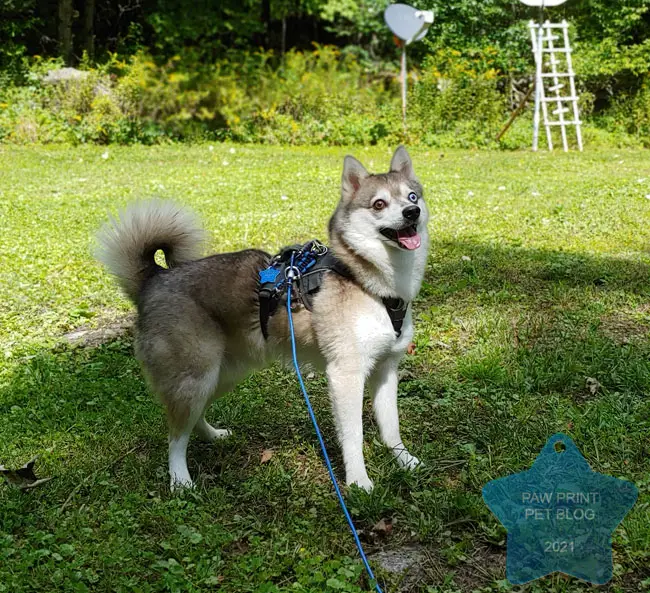
Dogs and Poison Ivy
I’ll spare you any images of my gross swollen face, and instead share the adorable Mr.Fen playing in his new yard!

The most effective way to avoid transferring urushiol from your pet’s fur to your skin, barring just not coming into contact with urushiol in the first place, is to wash your pet.  If you suspect, or know, that your furry friend has come into contact with poison ivy, oak, or sumac, step 1 is to avoid touching them as much as possible.  Give him/her a bath as soon as you can, using soap because, remember, urushiol is an oil.

Dish soap isn’t something I commonly recommend using on pets, but it can be a good way to remove urushiol from fur due to it’s ability to effectively remove oils.  It can be helpful to wipe down your dog after hikes or walks in the woods, even if you didn’t notice any poison ivy, just in case.  Pay special attention to their paws, legs, and bellies as those are the areas most likely to come into contact with urushiol containing plants.  Unless your dog is like my Fenrir, then wipe down the whole darned dog because he’s probably been rolling around all over everything.  Sigh.

Don’t forget to also wash things like your pets’ leashes, collars, harnesses, and any clothing items they (and you) were wearing.

Did You Know That Dogs CAN Get Poison Ivy Too?

Cases of animals developing rashes from plants like poison ivy are not nearly as common as in humans, but they do happen.  Urushiol can cause itchie, red rashes on dogs just like it does on people.  However, for the most part dogs’ fur prevents the urushiol from reaching their skin.  Dogs with no, or thin, fur, and dogs suffering from other skin conditions are more prone to urushiol reactions.  Small dogs, especially if they have bare bellies, are more at risk.  Poison ivy, oak, or sumac rashes on dogs will look very similar to those on humans.  Watch out for patches of skin that appear red, swollen, itchie, with blisters that may ooze a clear or yellowish liquid before scabbing over.

Poison ivy, and related plants, are also toxic to dogs if ingested.  It can cause symptoms of GI upset, such as vomiting and diarrhea, but, in rare cases, can cause more serious symptoms such as anaphylactic shock.

Conclusion:

Of course, as they say, when it comes to things like poison ivy, prevention is always the best ‘cure’.  A bit too late at this point, but I’ve started keeping Kit and Fen away from the borders of our yard where the poison ivy is.  Thankfully my face is getting a little less swollen everyday.  Since I really don’t want to repeat this experience again anytime soon, I’ll be being much more careful when it comes to avoiding poison ivy (and making sure my dogs avoid it too) in the future.

Comment below!  Are you allergic to poison ivy too?  Did you know that other animals can (rarely) develop rashes from it like people can, or that they can pass on the oils from their fur?

Dogs and Poison Ivy

How to Register Your Pet’s Microchip for Free


Did you know there are ways you can register your pet’s microchip for free?  Read on to learn how!

We’re moving….again.  Ah the joys of renting.  Although I didn’t write about it here, the whole process has been really stressful!  By the time you read this post, though, we’ll be in our new place!  We were very lucky to, after quite a long search, find an adorable little single family house with an amazing yard to rent.  I SO wish we had been able to buy instead.  The current housing market coupled with the fact that we weren’t really expecting to have to move right now left us unprepared.

Moving is a lot of work!  Besides all the packing and physically moving, we have to worry about stuff like setting up utilities, and updating all our accounts with our new address.  Kit and Fen will need new ID tags, new licenses, and I’ll have to update their microchip information. 

The 411 on Microchips

Register Microchip Free
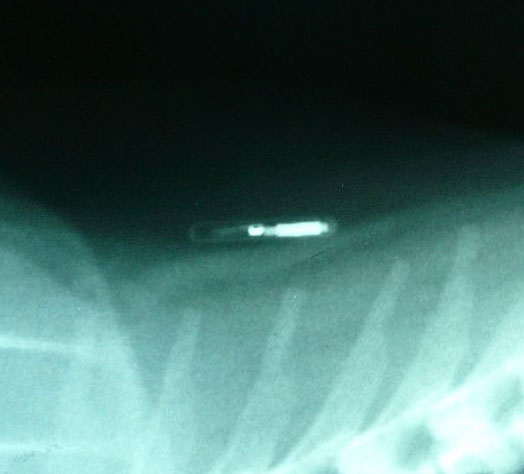
An x-ray image of a microchip. Photo via Joelmills, Creative Commons Attribution Share Alike 3.0 Unported license.

As most pet owners know, a microchip is an excellent means of permanent ID for our pets.  They are about the size of a grain of rice, and in cats and dogs are normally inserted under the skin between the shoulder blades.  Microchips themselves do not store any information besides a unique 9, 10, or 15 digit number.  These numbers can be read by microchip readers most commonly by veterinarians or animal shelter staff.

When your pet is scanned and determined to have a microchip, the screen on the chip reader will display your pet’s unique microchip number, as well as who the manufacturer of the chip was.  The chip number can also be searched on the AHAA Universal Pet Microchip Lookup websiteOpens in a new tab..  The AHAA website displays registries that a chip number has been registered on, in order of the most recent registration first.  Those registries can then be contacted and, as long as they have updated information on file, a missing pet’s owner can be contacted!

[AdsWithin]


Registering Microchips

Microchips are useless if they are not registered!  An unregistered microchip will mean that there is no owner information connected to that chip.  Most microchip companies have their own registry. Most of them include the initial registration of your chip into the price of getting your pet microchipped.  They then charge a fee later if you ever need to update your information.  Others charge an annual subscription fee.

For example, my older dog, Kitsune, has a microchip from the company 24PetWatchOpens in a new tab..  Way back when he was a puppy I got him microchipped during a clinic held by a local animal shelter.  The price I paid to get him microchipped included registration.  However, 12 years later, if I want to update my address through 24PetWatch I will have to pay to purchase a 24PetWatch membership.  It’s $29.95 for the first year, then $19.95 a year after that.  Or I could pay $94.95 for a lifetime membership.

Sadly, there is no universal microchip database.  I wish there was, that would make things so much easier!

Free Microchip Registries

There are, however, a couple of free microchip registries.

  • Found Animals Registry:Opens in a new tab. From the research I did, the Michelson Found Animals Registry might be one of the closest things to a universal national registry, and registering your pet’s microchip through them is free.
  • Free Pet Chip Registry:Opens in a new tab. I have never used this registry myself, but they are also a free pet microchip registry.

What I recommend When It Comes to Registering Microchips

Free registries are awesome, but having your contact information updated through a free registry only will be useless if the vet/shelter scanning your found pet doesn’t do enough digging to discover what registries you used.  Microchip scanners display not only your pet’s unique ID number, but the chip manufacturer as well.  Some shelter workers, busy as they are, don’t always go beyond calling the chip’s manufacturer.  That sadly means that you could have your updated information saved on as many registries as you want, but if it’s not updated through the chip’s original manufacturer, and that’s the only company the shelter calls after scanning your pet, then you’d be out of luck.

I know no one wants to spend money if they don’t have too.  If you can, I recommend registering your pet’s microchip through their chip’s manufacturer.  The free registries can be great as back up or secondary registries, or as a way to update your information quickly until you can afford to pay to also update them with the chip’s manufacturer.

Microchips Should Not Replace Traditional ID Tags

If my pet is already microchipped, and the chip is registered, why would they also need a traditional ID tag?  Microchips are not the end all be all to recovering lost pets.  Updated ID tags are still the best way to get your lost pet returned to you as quickly as possible.  Reading your phone number and/or address off an ID tag is so much easier than having to take a pet to a shelter or vet to get him/her scanned for a chip.

Now to find some cute new tags for Kit and Fen!  That’s one of the fun parts of moving, after all.  Comment below and let me know if you recommend any specific brand of ID tags for small dogs.  I’d also love to hear your experience using one of the free microchip registries, if you’ve used either of them before.

Register Microchip Free
Chip scanner image via Steffen Heinz, Creative Commons Attribution Share Alike 3.0 Unported license.

CENGCEN Pet Treat Camera Review


I’m sure many pet owners can relate – I hate leaving my two dogs home alone.  My partner and I both work from home.  It doesn’t happen all that often, but I still worry about Kit and Fen when I’m not home to keep an eye on them.  A few years ago I tried purchasing a pet camera.  But it didn’t work very well, and I ended up returning it.  I’ve thought about trying out other brands to see if I could find one that I like.  I just never got around to trying any more – until now!

CENGCEN pet cameraThis review is sponsored by CENGCEN.  I received our pet-treat camera for free in return for our honest review. As always, I strive to share only products I feel would benefit my readers and their pets.  All opinions expressed are my own.  This post contains affiliate Amazon links.  If you purchase products using one of my links I will receive a small commission at no additional cost to you.
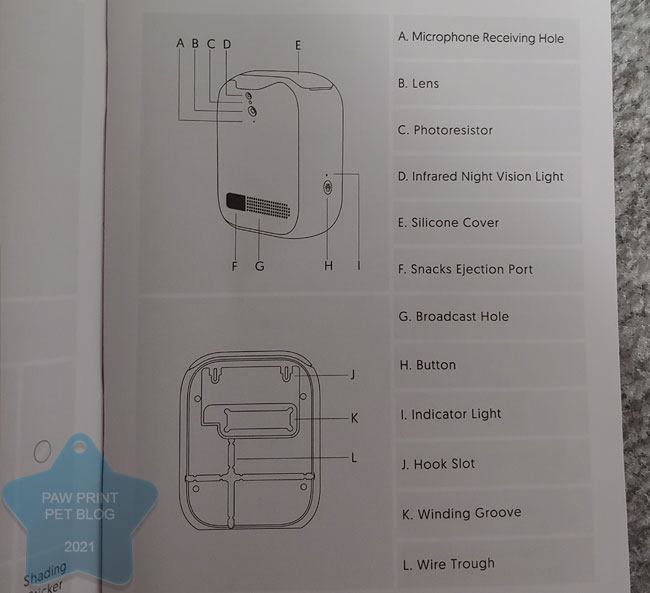
I was recently approached by a company called CENGCEN, who allowed me to try out their treat dispensing WiFi pet cameraOpens in a new tab.. I know pet cameras have come a long way since I last tried one out, and I was excited to try this one!  CENGCEN’s camera app is compatible with both iOS and Android (what I use) phones.  Their app connects to their pet camera through your WiFi and not only allows you to see your pet, but also to dispense treats, listen in on them, and talk to them too!

CENGCEN Pet Camera Features

The pet camera itself, arguably the most important feature, has an amazing 130* field of vision.  The app allows you to scroll back and forth to take control of the full field of vision, so you can still see your pet even if he/she is relaxing near the edge of a room.  You can activate the camera through the app anytime, and can also set your camera to auto record when it detects motion.   If you see your pet doing something especially adorable, you can even use the app to remotely take pictures and record video footage!

The app has a button you can press to tell the camera to dispense treats.  The camera makes a bell sound to alert your pet, then shoots treats out into the middle of the room.  I used pieces of kibble rather than treats, and the camera dispensed a small handful of kibble out into the middle of the room, where my dogs could sniff around and forage for it.

The camera also features 2 way audio.  You can use this feature to listen in on your pets, and also to talk to them through the camera!  I especially love this feature.  Kit and Fen can sometimes get a bit antsy when they think they’re home alone.  Using the camera’s audio I can talk to, and comfort them, if they appear to be getting nervous without me there.

The camera  comes with a wall mounting kit that doesn’t require you to drill into your wall – perfect for people, like me, who rent their home!  It also works well just placed on a desk or table, out of your pet’s reach in case he/she decides to try to figure out how to get the treats out themselves.  Another feature I love is that you can share your pet treat camera account with up to two additional users.  This way I could allow my partner to monitor the camera from his phone too.

[AdsWithin]

Our Experience Using the CENGCEN Pet Camera

CENGCEN pet cameraDownloading the app and setting up the camera was pretty easy.  When you first set it up you’ll need to make an account and connect your camera to your WiFi network, so you will need to know your WiFi password.  The instructions that come with the camera, along with the app, do a pretty good job at walking you through the setup process.  The hardest part, for me, was figuring out where to get the app.  I couldn’t find instructions for where to find it so I just ended up searching for “CENGCEN” in the app store and found it that way.
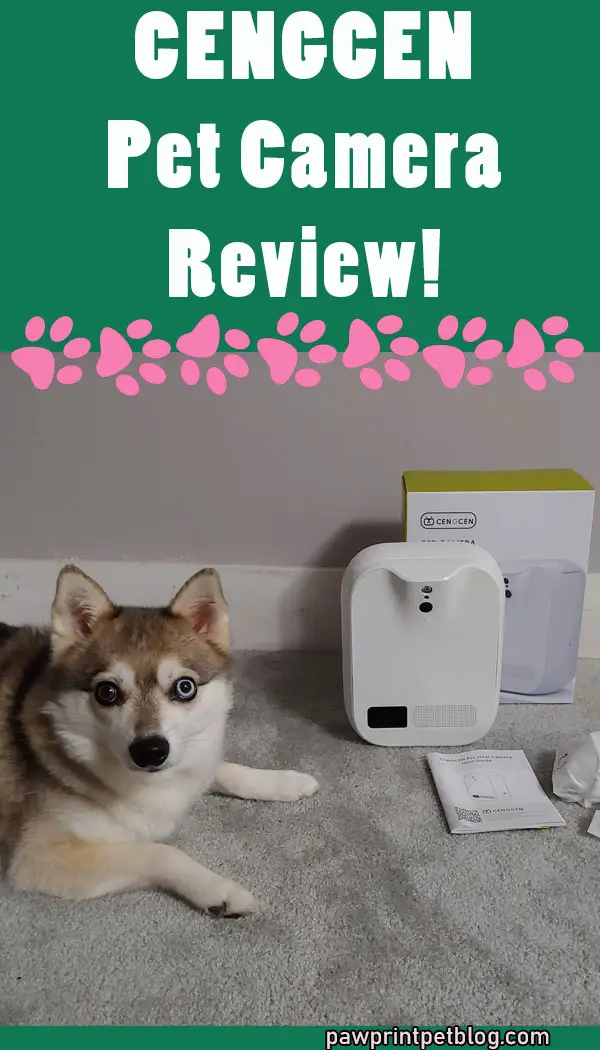
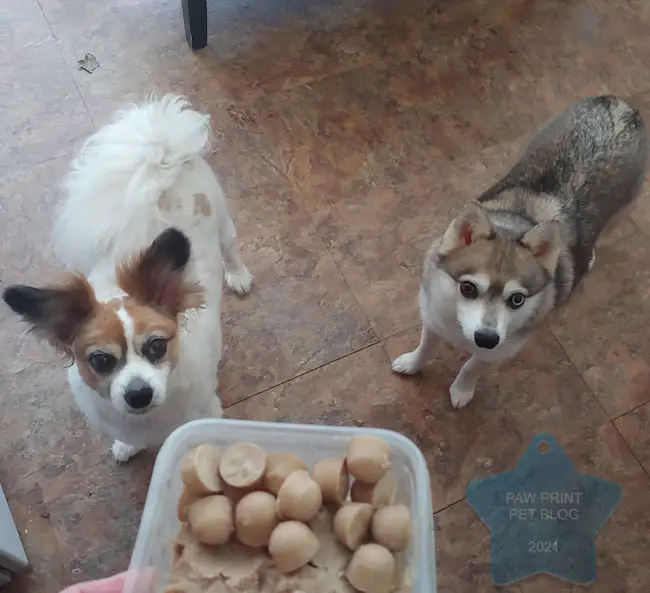
All the features the camera is supposed to have – 2 way audio, treat dispensing, 130* of vision – worked well for me!  As you can imagine, Kitsune especially LOVES the treat dispensing feature.  I was able to take both photos and videos remotely with this camera.

I found the app to be a little bit finicky at times.  I’m unsure whether it was an issue with the app itself or my phone.  A handful of times I’ve gotten error messages when I try to view the camera feed on my phone.  However, the few times it happened I was able to fix it by restarting my phone.  It makes me wonder if the issue could have something to do with my phone.  Or, perhaps with my WiFi connection, which can be spotty at times.

I’m including our video review here too, for anyone who wants to take a look at what the app and the footage from the camera looks like!

So Do I Recommend the CENGCEN Pet Camera?

I’m really impressed with this camera!  I will for sure continue to use it for my own pets.  The CENGCEN pet treat camera currently retails new for $109.99 on AmazonOpens in a new tab..  A bit expensive perhaps, but can you really put a price on piece of mind?  If you’re interested in getting one for yourself, you can use the code CENGCEN1 to get 10% off your order until the end of next month, 9/30/2021.

 Comment below!  Have you ever tried using a pet camera to keep an eye on your pet while you’re away?

CENGCEN pet camera

Recipe: Peanut Butter & Banana Ice Cream for Dogs!


New England summers can be so weird.  Last week we were suffering through a heat wave, then this week we’ve had some nights that got so chilly I broke out wool socks and a hoodie.  We don’t have air conditioning, which most of the time is no big deal but, as you can imagine, can make getting through heat waves a bit tough.  I’m always on the lookout for fun ways to help keep my dogs cool during the heat of the summer.  I’ve purchased them doggy ice cream from our local grocery store in the past, and both KitsuneOpens in a new tab. and FenrirOpens in a new tab. really liked it.  During last week’s heat wave I decided to break out my ice cream machine and try my hand at making them homemade ice cream – because why not!?

Making Homemade Treats For My Dogs

dog ice creamFor the most part, I home make my dogs’ treats.  Yes, it’s more work, but I enjoy cooking.  I like knowing exactly what ingredients are in my dogs’ treats and hey, if your dog is anything like mine you’ll never find anyone more appreciative of your home cooking than your dog!
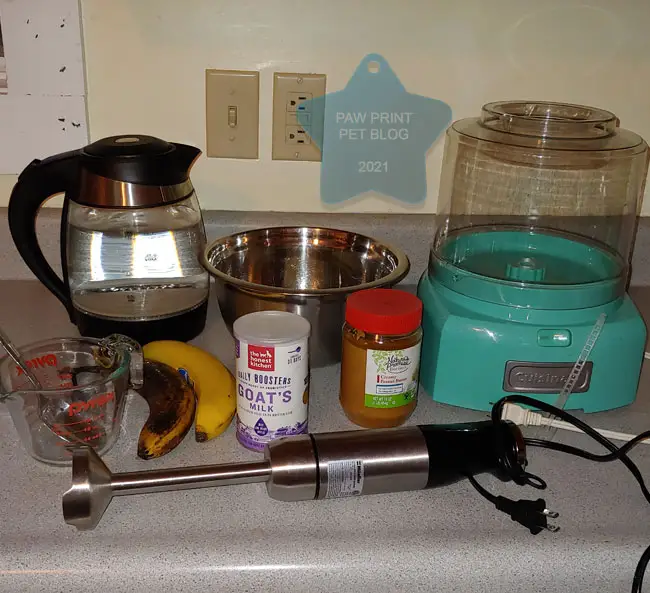
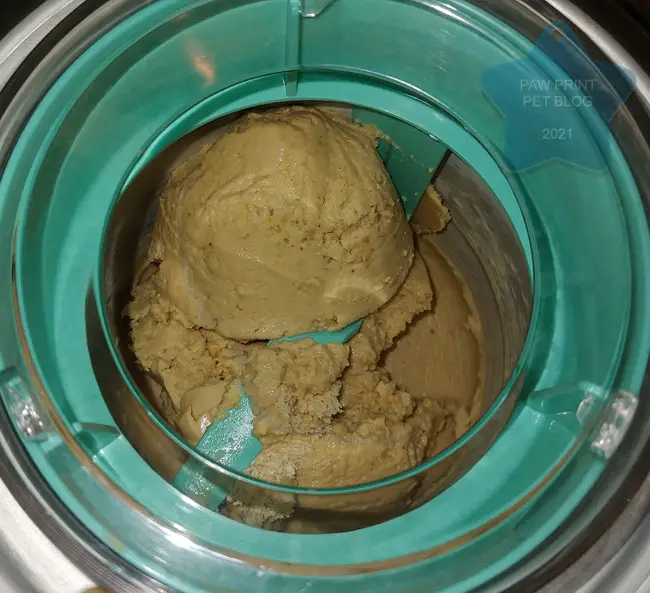
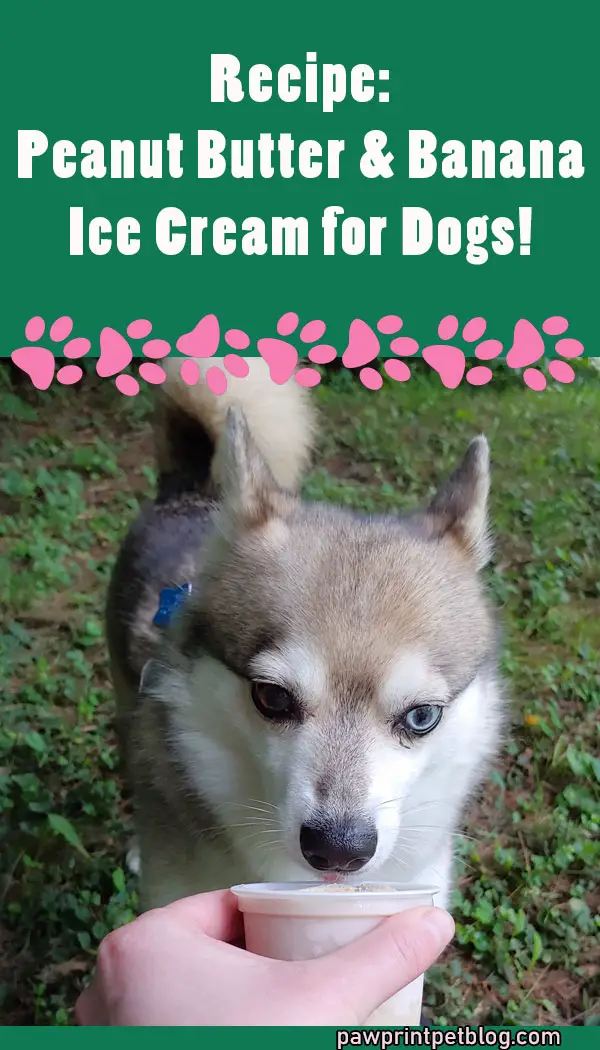
Today I’m going to share the recipe I came up with last week.  I’d say it was a success, as both Kit and picky Mr.Fen enjoyed it.  I like to keep my dog treat recipes as simple as possible, easy to make with a limited number of ingredients is the name of the game.  This not only makes the treats easier to make, but cheaper, and easier to adjust if your dog has allergies or you don’t have a certain ingredient on hand.

Disclaimer: This post contains Amazon affiliate links.  If you purchase something using one of our links, we will receive a small commission at no additional cost to you.

[AdsWithin]

Peanut Butter & Banana Ice Cream for Dogs:

You will need…

  • A base for your ice cream (2 cups).  I used goat’s milk made with The Honest Kitchen’s powdered goat’s milk (powder mix that you add to water).  I originally wanted to use regular goat’s milk, but my local store was sold out.  Goats milk is full of healthy probiotics and enzymes that are good for your dogs’ digestion.  If you can’t get goat’s milk, regular milk or dog safe (no xylitol) yogurt should work too.
  • Bananas (2). Bananas are low in calories, cholesterol, and sodium, but high in potassium, biotin, fiber, and vitamins.  Many dogs enjoy the taste of bananas.
  • Dog safe peanut butter (1/2 cup). Always check the ingredient lists of foods to make sure they don’t contain any ingredients that could be dangerous to your pets.  I try to use peanut butter brands that are as natural as possible, without a lot of added ingredients like sugar.  Peanut butter is high in calories and should only be fed in moderation, but is a good source of protein, niacin, healthy fats, and vitamins B and E.
  • A blender.  I’m kind of obsessed with my immersion blenderOpens in a new tab., but any blender should get the job done.
  • A mixing bowl.  To mix and chill your ingredients in.
  • An ice cream maker, ice cube tray, or some other container to freeze your ice cream in.  When I was experimenting with this recipe I tried freezing the ice cream with both an ice cream makerOpens in a new tab. and just in regular ice cube trays.  The ice cream frozen in the ice cube tray came out much harder.  I preferred the results I got in my ice cream maker, but both worked.  My dogs readily ate the ice cream both ways.
  • A measuring cup and spoon. For measuring and mixing.

dog ice cream
Steps:

  1. Prepare your ice cream base.  Since I used powdered goat’s milk, I followed the instructions on the milk container to make 2 cups of goat’s milk.  This basically involved mixing two teaspoons of the powder with 2 cups of warm water.
  2. Blend your base together with 2 bananas and 1/2 a cup of peanut butter.  I used my immersion blender to blend all my ingredients until they were mixed thoroughly.  A regular blender, or even hand mixing, would work too.
  3. Chill your mixture.  If you’re using an ice cream maker, prep your machine.  Next I stuck my ice cream mixture in the fridge to chill, and my ice cream machine bowl in the freezer.  Skip this step if you’re using ice cube trays, or some other type of container, to freeze your ice cream.
  4. If you’re using an ice cube tray, fill your tray with your ice cream mixture and freeze!  Making the ice cream this way is actually a bit easier, but leads to harder/denser frozen treats.
  5. Once your ice cream machine bowl is frozen, follow machine instructions to make ice cream.  Using my ice cream machine is super simple.  Once the bowl was frozen I just put it on the base, popped in the ice cream mixture, and turned it on.  It took around 20 minutes or so for my ice cream to be complete.  You’re looking to achieve a texture similar to soft serve.
  6. All done!  Enjoy.  Ice cream can be stored in the freezer.  If it hardens too much in the freezer, you may want to let it sit out for a bit before giving your dog a scoop or two.  Remember that treats should be offered in moderation. 

dog ice cream
Kit and Fen have really been enjoying their own personal doggy ice cream!  Even Fenrir, who doesn’t normally like bananas and is a super picky eater, has been enjoying this special treat.  It’s so funny, the boys have been getting super excited every time they see me open the freezer now.  Their doggy ice cream is an excellent way to help them cool down a bit on a hot day.  Because I know exactly what’s in it I can feel extra good about treating them.

What do you think?  Have you ever made ice cream for your pet?  Do you think he/she would like it?  What other flavor ideas can you come up with? 

dog ice cream

Pros and Cons of Using House Call Veterinarians


Have you ever considered using house call veterinarians for your pet?  They seem to be growing in popularity, and are available now to treat pets in more locations than ever before.  When we still lived in the city, for many years I kept the contact info of a house call vet.  I never actually called them, though.  Our regular vet was awesome and only a few blocks away from our apartment.  When we moved in 2019, way out to the middle of nowhere, I was surprised to find out that there’s a house call veterinarian that serves our new location too.

A house call veterinarian is a veterinarian who, often accompanied by an assistant or technician, travels to your home to provide your pet with medical care.  Many owners will have heard of at home euthanasia.  That is just one of many services that a house call veterinarian can provide.  House call veterinarians are sometimes also referred to as mobile vets.

[AdsWithin]

Is a House Call Veterinarian Right for You and Your Pet?

I put together a list of some of the pros and cons associated with mobile vets to help you decide…

Pros of Using a House Call Veterinarian:

  • Convenience – Mobile vets can be amazing for people who, for any reason, have difficulty traveling to take their pet to see a vet.  Whether you don’t drive, have mobility issues, or don’t have a regular vet that’s close to you, a mobile can be a convenient option.  They can also make life easier if you have a pet that’s difficult to transport, like one that is elderly, sick, has mobility issues, gets stressed during car rides, or is too large to transport easily.
  • Less Stress – For some pets, spending time in an animal hospital is stressful.  A stressed out pet oftentimes leads to a stressed out owner.  Mobile vets can provide veterinary care in the comfort of your own home!
  • More Accurate Observation – How many times has this happened to you?  You notice your pet has a health issue, such as a limp.  You make an appointment with your vet, and as soon as you walk into the office your pet is suddenly perfectly fine.  How frustrating!  Your vet can, of course, take a guess at what might be wrong.  But without being able to witness the issue it can be hard to offer an accurate diagnosis.  Having your vet visit your home can not only allow your vet to more accurately observe your pet’s behavior, but seeing his/her home environment can sometimes offer important clues to what might be wrong with a sick pet.
  • Easier to Treat Multiple Pets – This is one that would be a big pro for me.  I have two dogs.  I hate taking them both to the vet at the same time.  My older dog, Kitsune, loves going to the vet and wants to run around and say hello to everyone.  My younger dog, Fenrir, is shy and fearful around people he doesn’t know well.  Managing two dogs with such different personalities in a busy vet waiting room is not a fun task.  For that reason, I take my dogs to the vet separately.  Utilizing the services of a mobile veterinarian can be a great way to have multiple pets seen at once, without having to worry as much about how you’re going to keep them all comfortable.
  • Fostering a Stronger Relationship with your Vet – Mobile vet practices are usually a far cry from large, impersonal, city vet practices.  While large, highly advanced, vet hospitals have their place, there’s really something to be said for being able to form a relationship with your vet.

Cons of Using a House Call Veterinarian:

  • Cost – House call veterinarians can be, understandably so, more expensive than traditional vets.  You’ll not only be paying for whatever medical services your pet requires, but additional fees to help cover the vet’s transportation costs.  Because they have to spend time driving from house to house, mobile vets are not usually able to see very many patients a day.  This may lead to them having to charge more per patient.
  • Scheduling Issues – House call veterinarians will probably not be your best option during an emergency.  They have to strictly schedule out their routes each day.  House call vets don’t have very flexible schedules.  If your pet is sick or injured, you’ll probably have to take them to an emergency clinic.
  • Limited Services and Treatment Options – Mobile vets can provide many services in the comfort of your home.  But they can’t do everything.  If your pet needs more advanced diagnostics, such as x-rays, house call vets will often refer you to a local brick and mortar location.  They may be able to do things such as take blood for blood work or skin scrapings.  However, since they can’t run tests in your home you’re not going to get immediate results.  If your pet requires a complex treatment such as surgery, a house call vet will usually either have you travel to their physical clinic (if they have one) or refer you to another veterinarian.
  • More Stress for Some Pets – Being seen in their own home could be more stressful for some pets.  It really depends on the pet.  Some dogs, for example, get upset or overly excited when new people enter their home.

What do you think?  Have you ever used a house call veterinarian?  If not, would you ever consider using one?

I’ve yet to use a mobile vet for my own dogs.  In all the places I’ve lived in since getting dogs, I’ve been lucky to have amazing vets pretty close by.  I like the idea of taking my dogs to a more full service vet.  But I can see why using a house call veterinarian would be an excellent option for some owners.  I won’t write off the possibility that I’d be open to using one myself at some point in the future.

House Call Veterinarians

The Power of Cute!


I should probably be one of the most productive people on Earth, if a study by Japanese researcher Hiroshi Nittono has any truth behind it.  Nittono and his team studied how viewing kawaii (cute in Japanese) images impacts behavior, and specifically how they impact performance on tasks requiring focused attention.  For anyone interested, you can read more about the study hereOpens in a new tab..

Can Viewing Kawaii Animals Really Increase Focus!?

During the study, university students were asked to preform tasks requiring high levels of concentration.  Students were subject to viewing sets of images before completing tasks.  While some students were shown images of baby animals (kittens and puppies), others were shown adult animals (dogs and cats), images of food, or neutral objects.

Power of CuteNittono concluded that viewing cute images (specifically pictures of baby animals) improved task performance.  Viewing images deemed to be cute increased performances in fine motor dexterity, non-motor visual search tasks, and focus.  So cute images can not only help to improve our mood, but may also positively impact our behavior!  So maybe the next time you catch one of your coworkers sneaking a peak at pictures of puppies instead of working, you’ll cut him/her some slack.

“Kawaii things not only make us happier, but also affect our behavior. This study shows that viewing cute things improves subsequent performance in tasks that require behavioral carefulness, possibly by narrowing the breadth of attentional focus. This effect is not specific to tasks related to caregiving or social interaction.” (Nittono et al., 2012)

Speaking of Kawaii…

This past Sunday, August 1st, we celebrated Fenrir’s 6th birthday!  I really have no idea how my little one is 6 already.  How cute is he though?  He still looks (or at least I think so), and acts, like a puppy!  On Saturday we took the boys hikingOpens in a new tab..  We got thunderstorms and rain on Sunday, but since we had spent most of the day before outdoors, it was nice to have a relaxing day inside.  The storm ended up knocking our internet out for most of the day, which I know sounds like a bad thing, but it was actually kind of nice to have a day indoors without the distraction of the internet.  The boys got a few special treats, and presents!  I say the boys instead of just Fen, because we spoiled sweet Mr.Kitsune too.  Birthdays in our house are a family affair – we wouldn’t want anyone to feel left out.

I just wish I had thought to wrap a present or two for Kitsune!  Even though he did get new toys and treats, I didn’t wrap his.  He reminded me of when I was a kid, when someone would get presents on their birthday and my little sister would get jealous!  Kit kept finding pieces of wrapping paper on the floor and trying to ‘unwrap’ them like they were gifts.  Next year, on Fen’s birthday, I’ll try to remember to wrap a few things for Kit to open too.

I’m so proud of Fenrir.  He’s such a loving, playful, fun little friend.  He’s my shadow, my almost constant companion, and his silly, playful antics bring me so much joy.  Happy 6th birthday to my little wolf cub – here’s to many, many more!

Power of Cute

References:

Hiroshi Nittono, Michiko Fukushima, Akihiro Yano, Akihiro Yano, & Hiroki Moriya. 2012. The Power of Kawaii: Viewing Cute Images Promotes a Careful Behavior and Narrows Attentional FocusOpens in a new tab.