Recent Posts

Tips for Traveling with Your Pet


Traveling with animals isn’t always easy!  I remember back in my city days, before I had a car complete with a personal chauffeur (my fiance Chris) I used to have to use public transportation to get around with my pets.  Thankfully, many of the trains and buses in the city we lived in allowed animals.  Lugging 20 lb Kitsune around in a carrier always made me thankful I opted to keep “small” dogs!  Now that we have our own car, traveling with Kit and Fen is a lot easier, although not completely without its hurdles.  Keep reading to see our tips for traveling with your pet!

663

[AdsWithin]


The winter holidays are fast approaching, and with Covid restrictions easing in many places, people may be starting to plan holiday trips.  Traveling seems to be one of those things that some people end up sacrificing if they have pets.  I know I always feel guilty about leaving my dogs behind, especially now that Kitsune is getting older.  If you’re able to, taking your pet on trips with you can be a lot of fun.  Make sure you plan your trip ahead of time, to make your travels as stress free as possible for you and your pet.

For anyone traveling by car, here are some pet travel tips:

  • Keeping your pet in his/her crate or carrier during travel can help to ensure your pal’s safety and comfort.

It will decrease the chances of your pet distracting you while you’re driving.  You can work towards getting your pet used to his carrier before your trip, so it becomes a comfortable/familiar place for them.  Always be sure to secure your pets carrier inside your car so it doesn’t get jarred around too much.

  • If you plan your trip far enough ahead of time, you can use the extra time to gradually get your pet used to spending time in the car.

Help your pet get used to their crate, even take them on short drives so they gets used to the movement of the car.

  • Remember not to leave your pet alone in your vehicle.

There’s been a lot of awareness raised about the dangers of leaving a pet in a hot car.  Cold weather can be just as dangerous!

  • Keep in mind that it’s not uncommon for pets to suffer from motion sickness.

It’s usually best to feed your pet at least three hours before your trip starts, depending on species.  But keep in mind that some pets, such as rabbits, should not go without food even while traveling.

  • It might look fun, but don’t allow your dog to stick their head out the window.

Flying objects can cause injury, especially to sensitive eyes.

  • Create a pet travel kit to bring along with you.

It can include items such as a favorite toy, travel papers, food, a first aid kit, and cleaning supplies.  Keep in mind that pets may make messes in your car, especially if they are not used to traveling, so plan accordingly.

  • I mentioned travel papers.

Especially when traveling across state lines, make sure to bring your pet’s vaccination records.  Also make sure your pet has some form of ID – a microchip, collar, and/or a travel tag that you can attach to your pet’s carrier.  Since you are traveling, make sure the contact number listed is one you’ll be able to access while away from home.
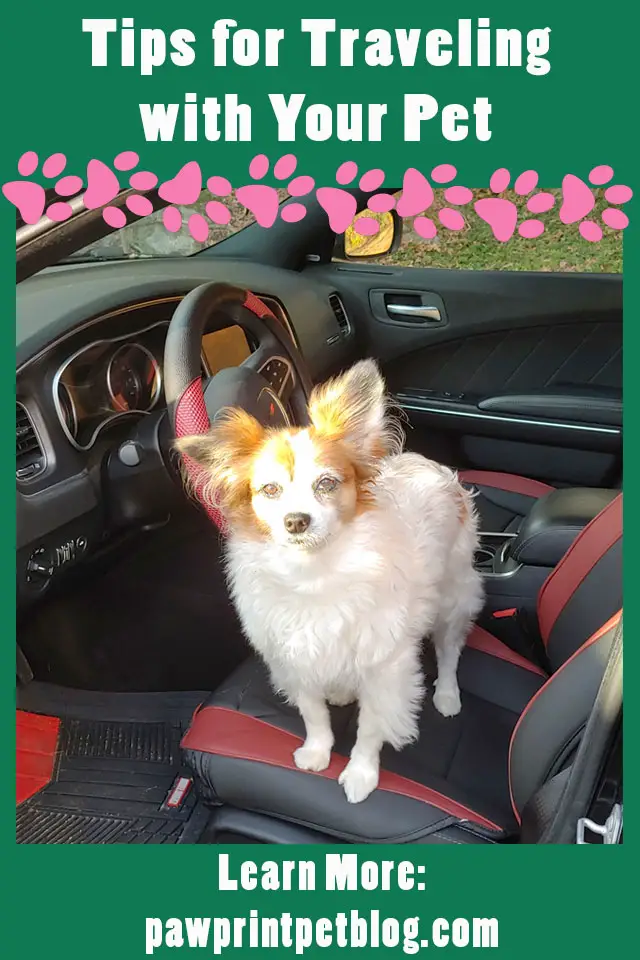
Traveling with Your Pet

Always Plan Ahead!

If you are traveling by some means other than car, it’s still important to plan ahead of time.  Some forms of public transportation that allow pets require you to check in earlier than normal if you have a pet with you.  Not all trains (etc) allow pets.  Some charge extra for “pet tickets” and require you to book in advance.  Always call ahead to ensure you are well prepared on travel day.

Make sure that once you reach your destination your pet will have a safe place to stay, whether it’s at a family member or friend’s house, or in a pet friendly hotel.  Remember that traveling, then being in new surroundings, can be a stressful experience for your pet.  Some pets will adapt better to traveling than others.  Make sure you provide your pet with a quiet, safe place to relax and de-stress.

Comment below!  Do you travel with your pet(s)?  What are some things you do to make sure your adventures are a pleasant experience for everyone? 

 

The Benefits of Apple Cider Vinegar for Dogs


sChances are, you have already heard a bit about the benefits of apple cider vinegar (acv) for dogs.  No stranger to acv (I use it in my hair), I personally learned about it’s potential benefits for dogs while searching for natural ways to help soothe Kitsune’s itchy skin.  Kitsune has both food and environmental allergies, the latter of which used to really irritate his skin.  Thankfully, over the years I’ve gotten good at managing Kit’s allergies, so he rarely has a bad flair up these days.  Besides allergy relief, apple cider vinegar is said to provide a plethora of health benefits for our furry friends.

66

So exactly what can apple cider vinegar do for your dog?

  • Used topically, acv can condition the fur (and human hair too!), help fight bacterial/fungal skin infections, and soothe the skin.
  • It is also said that acv can help to naturally repel biting insects such as fleas and ticks.  You can add a few teaspoons of acv into a spray bottle filled with water.  Use the spray on your pet before going into areas where contracting fleas/ticks is a concern.  Just make sure, when using vinegar topically, to keep it away from your dog’s eyes (it stings)!
  • Given as a dietary supplement, acv is said to have many benefits such as helping to relieve arthritis, improving digestion, aiding in bladder and kidney health, re-leaving allergy symptoms, and fighting against fungal/bacterial infections.
  • Acv is said to be able to help prevent tooth decay and may improve bad breathe.
  • Acv can be used to clean ears, paws, etc., and can help prevent yeast infections.
  • Many owners have reported that acv, used as a dietary supplement, has been able to greatly reduce or even eliminate their pet’s tear stains.  It’s much healthier than many of the products sold for this purpose.
  • I use acv as a nontoxic cleaner to clean up after my pets.  It does a great job at eliminating urine odors if your pet has an accident.  Acv can be used to clean pet dishes and counter tops rather than using harsh chemicals.

[AdsWithin]


Are all brands of apple cider vinegar created equal?

Not necessarily.  How picky I am about what type of vinegar I buy depends on what I’m planning on using it for.  If I’m buying acv to rinse my hair, or clean my counter tops, I usually just go for the cheapest bottle of store brand acv.  However, if I’m buying it to mix in with Kitsune’s food, I end up buying more expensive brands.  Always the best for my furry friend.  But there is a reason why I pay more for the higher end acv if I’m planning on using it as a supplement.

If you’re going to add apple cider vinegar to your dog’s food or water, you want to look for acv brands that say they contain ‘mother’.  The mother of the acv will usually appear as a cloudy sediment on the bottom of the jar.  You may have noticed that this is absent in some brands of acv.  It’s a weird sounding term, but the mother is basically a collection of things like good bacteria, enzymes, and proteins.  It is widely believed that the mother of the acv is the part that contributes most to its health benefits.

How much apple cider vinegar should I give my dog?

Apple Cider Vinegar for DogsI mix acv in with Kitsune’s food usually twice per week, sometimes more often if his allergies are bothering him more than usual.  I only give him a teaspoon at a time.  Kitsune is 20 lbs.  Be careful about adding too much acv to your dog’s water or food.  It has a strong smell and flavor and may cause your pet to refuse his/her food if too much vinegar is added.



Topically, I use a mixture that’s 50% acv and 50% water.  As I said before, just be very careful to keep vinegar, even when diluted, away from your pets’ eyes.  If your dog has any open wounds, or his skin is raw/inflamed, using acv can sting.  Do not insert acv, or anything else for that matter, into your dog’s ears if s/he has an active infection without first consulting your vet.

Apple cider vinegar is a natural supplement that you can feel good about giving your furry friend.  However, like with any new food/supplement, always take your individual pet into account.  If you have any questions about introducing a new supplement into your pets’ diet, always make sure to do your own research, and talk with your pet’s veterinarian.

Have you ever used apple cider vinegar for your dogs?  Have you noticed any improvements to his/her health?

Apple Cider Vinegar for Dogs

How to Choose a Halloween Costume for Your Dog


Halloween is right around the corner, and what’s cuter this time of year than an already adorable dog dressed up in a cute or silly Halloween costume?  Dressing up our pets can be a fun way to involve them in our Halloween festivities, even if they can’t be involved in other holiday traditions such as trick-or-treating and eating candy.  However, it’s important to remember that Halloween costumes should be comfortable and safe for our furry friends!  Nobody wants to spend their holiday being uncomfortable, or worse in the emergency room, our pets included!  So if you are planning on dressing your pet(s) up this Halloween, have fun, but remember to stay safe as well!  Here are some tips to follow when picking out a costume for your furry friend…

dog halloween costumes

Just a heads up, this post does contain a few Amazon affiliate links.  If you click on one of our Amazon links and make a purchase, we’ll receive a small commission at no additional cost to you.

Avoid hot costumes:

dog halloween costumes

I’m not talking about hot dog costumesOpens in a new tab., necessarily, but costumes that are too hot for your pet.  Keep in mind that pets can’t sweat to keep cool like we can,  and most of them already have a fur coat to keep them warm.  Try to avoid costumes that are too thick, because they may make your pet too hot, especially if he/she is planning on attending a crowded Halloween party.  Look for costumes that are made of thin, breathable materials, or ones that don’t cover large portions of your pet’s body.

Watch out for choking hazards:

Pets, dogs especially, like to chew.  Fancy pet costumes that contain attachments such as beads or other small pieces may pose a choking hazard to curious pets.  Costumes that have bits that may be annoying for pets to wear, such as hats or shoes, may encourage pets to chew on the costume in an attempt to remove it.  Keep this in mind when choosing a costume, and try to avoid small or annoying parts that your pet could chew and/or possibly choke on.

Don’t compromise your pet’s senses for the sake of cute:

Eye patches, hats, funny glasses, and silly masks may sound like they’d make cool costumes, but don’t dress your pet in anything that will compromise his/her senses.  Blocking your pet’s eyes, mouth, nose, or ears will be uncomfortable and could be a frightening experience for your pet.

Choose non-confining costumes:

Your pet should be able to move around freely and naturally while wearing his/her costume.  Confining costumes can frighten and even hurt pets.  Make sure your pet can move around freely in his/her costume, and also that the costume does not block your pet from being able to use the bathroom normally.  Make sure to measure your pet and choose a correctly sized costume, as outfits that are too loose or too tight may restrict normal movement and be uncomfortable.

dog halloween costumes

Sometimes simple is better:

Sometimes something as simple as a festive bandana or leash can be enough to give our pets some holiday flair without making them uncomfortable.  Remember that holidays are suppose to be fun!  If your pet doesn’t enjoy wearing his/her costume, it’s unfair to make them wear it for long periods of time.  Maybe use that fancy costume to snap a few pictures, then replace it with a holiday themed collar, leash, bandana, harness, etc. to allow your pet to keep to the holiday theme while still being comfortable.

Listen to your pet:

Most importantly, listen to your pet.  Keep an eye on him and if he appears uncomfortable in his costume, remove it.  Most owners should find it easy to tell when their pet has had enough.  Don’t overdo it.  Wearing a costume for a short amount of time may not phase your pet, while costumes left on for too long may start to get annoying and uncomfortable.  Don’t force your pet to wear anything that he/she isn’t comfortable with.  After all, we want our pets to enjoy holidays with us, not suffer through them.

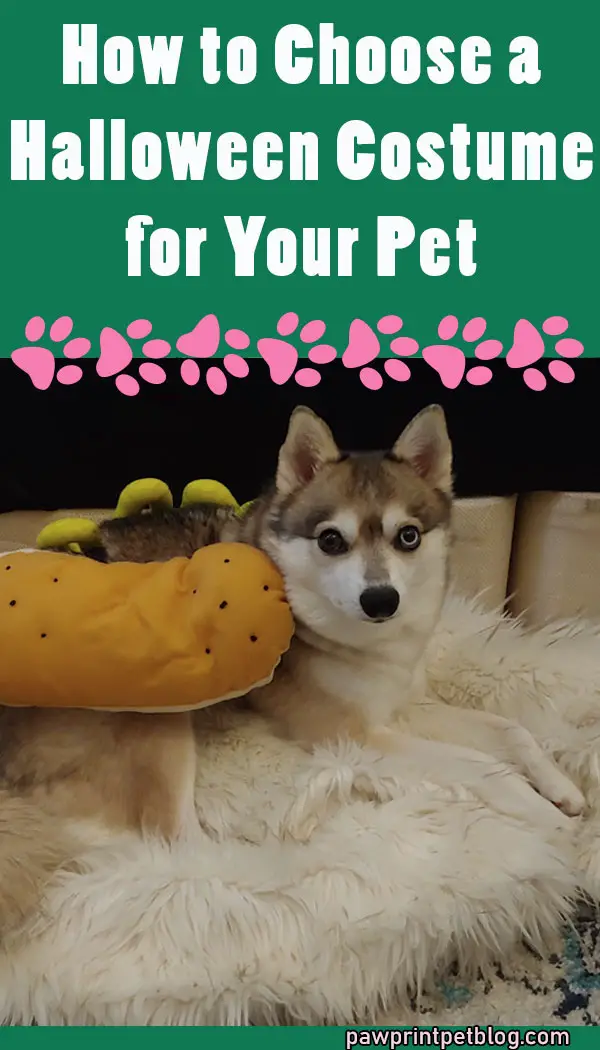
Are there any other factors you take into account when selecting a costume for your pet (if you bother dressing them up in the first place)?  My dogs, KitsuneOpens in a new tab. and FenrirOpens in a new tab., have been used to wearing things like harnesses and sweaters/jackets since they were pups.  I think that’s probably why they’re so tolerant of silly Halloween costumes!  The pictures of them dressed as hot dogs are actually from last Halloween.  This year I got them cute “costume” hoodies (this bear oneOpens in a new tab. for Kit and a moose for FenOpens in a new tab.) thinking that they’d be cute for Halloween, but the boys can also wear them to stay warm on cold winter days.

Since we moved out of the city, our last couple of Halloweens have been super low key.  We don’t get any trick-or-treats to our rural home, but we still try to celebrate and have some fun.  We’ll still be carving pumpkins, watching Halloween movies, baking treats, and, of course, we’ll have an adorable little ‘bear’ and a ‘moose’ running around the house.  If you normally celebrate Halloween, are you doing anything fun to keep the spirit of the holiday alive despite the pandemic?

[AdsWithin]

Homemade Halloween Treats for Your Dog


Homemade dog treats are a cheap and healthier way to treat your dog this Halloween!  Homemade cookies lack the preservatives and other unhealthy ingredients that are found in most commercial treats, are fun to make, and dogs love them!

Halloween dog treatsI first posted this recipe back in 2011, and it’s still to this day one of my dogs’ favorite treats!  Even my Alaskan Klee Kai, Fenrir, loves these – and that’s saying a lot.  He’s a very picky eater.  Despite not containing all that much peanut butter, I’m always tempted to try one of these cookies while I’m baking them because they smell so similar to (human) peanut butter cookies.  Pumpkin has quite a few health benefits Opens in a new tab.for dogs, including being high in fiber.  It’s a common ‘go to’ ingredient for dog owners when their furry friend’s tummy is feeling off.  Besides being an extra tasty way to get some extra fiber into your pooch, the pumpkin gives these treats a fun, natural orange color that is perfect for celebrating fall!

Halloween dog treats

Kitsune’s Spook Snack Peanut Butter and Pumpkin Dog Treats

Ingredients:
  • 2 1/2 cups flour
  • 2 eggs
  • 1 cup plain (100% pure) canned pumpkin
  • 3 tablespoons peanut butter
  • 1/3 cup water

* This recipe makes quite a few treats, depending on what size you make them.  Feel free to half the recipe if you’re looking for a smaller amount of treats, or want to make sure your dog likes these before making a ton!

[AdsWithin]

Halloween dog treats

Baking Instructions:
  1. Preheat oven to 350*F (175*C).
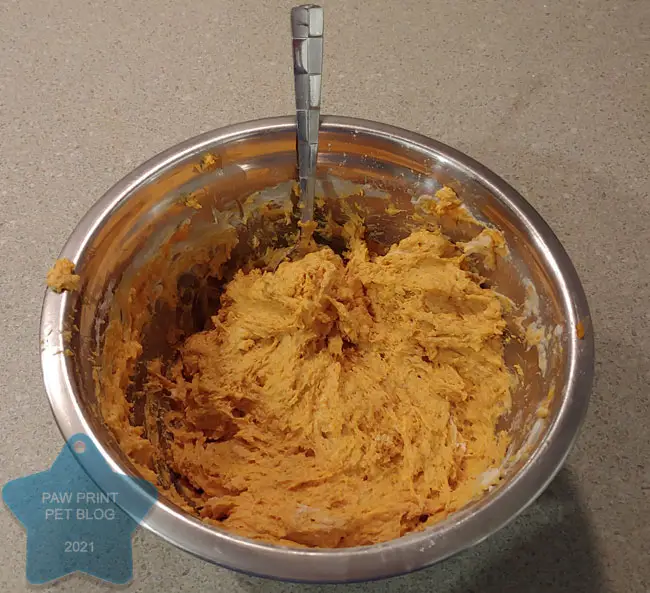
  2. Mix ingredients together.  The dough will be sticky (see photo above).
  3. Shape dough into rounded treat sized balls and place on an ungreased cookie sheet.  Feel free to play around with the size of your treat balls.  Smaller treats work better as training treats.  Larger ones work better if you’re using this recipe as a palatable way to offer your dog some pumpkin.  I like to make a combo of different sized treats – some small and others larger.  Tip: Keeping a bowl of warm water nearby and wetting your hands while shaping the treats can help to make the dough feel less sticky.
  4. Bake until the treats start to turn slightly brown and feel firm on the outside.  30 minutes has always worked perfectly for me when I make this recipe.  These treats are on the softer side, especially on the inside, as long as you don’t over bake them.
  5. Let cool, and let your dog enjoy!
  6. Because they do not contain any preservatives, uneaten treats last longer when stored in the refrigerator.

Enjoy!!  If you try out our Halloween dog treats recipe, you’ll have to let us know how they turn out.  Happy (early) Halloween and (late) fall!  Comment below!  What is your pet(s) favorite kind of treats?  Do you give them any special kinds to celebrate fall, or any of the fall holidays?

Halloween dog treats

How to Help Homeless Pets Even if You Can’t Adopt


I’ve totally been hit with a case of puppy fever!  However, I’ll have to live vicariously through those of you who are able to add a new furry family member into your lives.  Two high energy, high maintenance, dogs are my limit, at least for now.  Despite not technically being puppies anymore, my two manage to keep me plenty busy!

On the bright side, I feel so blessed to have Kit and Fen in my life.  I know not everyone is as lucky.  Some rentals don’t allow pets.  Some people may love animals but be allergic to them, or financially unable to care for one of their own.  Whether you’re like me and already have your hands full with the animals you already have, or adopting a pet isn’t in the cards for you for other reasons, there are still some amazing things you can do to help animals in need!

Help Homeless Pets

  • Foster: Many animal shelters utilize a network of foster families to help care for homeless animals. Caring for animals in foster homes means that they are not submitted to the stress of living in a cage at the shelter. It also opens up more space in the shelter so they are able to take in and care for more needy animals. Having animals live in foster homes can help them get used to living in a home environment.  If you can’t afford to adopt an animal of your own, fostering might be a great way for you to help out. The shelter or rescue you foster for usually pays for fees associated with the animals care. All you usually have to provide is your time and love.
  • Donate: Donations are always welcome! Donated money can go a long way towards helping to pay for the care of homeless animals. If you are unable to donate money, consider donating items such as pet food, toys, and supplies. Even things like paper towels, old blankets and bath towels, garbage bags, cleaning supplies, or office supplies are usually highly appreciated.
  • Donate services or your time: Volunteer!  If you’re unable to spend time working with shelter animals directly, considering offering your services to help instead. For example, if you are an electrician or a plumber, see if the shelter can use your services. You could also help advertise, run a donation drive, or use your creativity to make things to sell then donate the proceeds. The possibilities are endless! See if you can find a way to use your talents, hobbies, or skills to help out.
  • There’s an app for that: With the world becoming more and more connected through the internet, lots of people are finding ways to help animals in need without ever even leaving their computer desk.  Whether it’s organizing online donation drives, or sharing information about your local rescue with your friends/followers, every little bit helps!  On of my all time favorite phone apps, for example, is WoofTraxOpens in a new tab..  WoofTrax helps you track your stats while you walk your dog- things like how far you traveled, maps of your routes, and how long you walked for.  It also allows you to raise money for a rescue of your choice just by walking!  What’s better than being able to raise money to help homeless animals by going for a walk!?

There are plenty of ways to make a difference in the lives of homeless animals.  I’m currently not able to foster or adopt.  I donate what I can, volunteer, and spend a lot of time raising awareness about responsible pet ownership.  I’m happy that there are ways I can make at least small differences in the lives of homeless animals.  Can you think of any other ways to help besides those I mentioned?  I’d love to hear about them in the comments below!

[AdsWithin]

Help Homeless Pets

Fenrir & The Toad


I totally have writers block this week!  I’ve been trying hard to post a lot of high quality, evergreen type content here lately.  But I still feel like I haven’t completely gotten back into the swing of things since we moved a couple of weeks ago.  Whatever the reason, my brain is just not firing on all cylinders right now and I figured, rather than trying to force myself to put out content that I don’t really feel like working on, that I’d tell you all about a funny story about when my dog, Fenrir, ‘met’ a toad.

This happened around a week or so before we moved from our old house.  You know how most pet owners have a lot of silly little nicknames for their animals?  Well my dog, FenrirOpens in a new tab., recently earned a new nickname – Toad Bait.

[AdsWithin]


There are a lot of toads around where we live.  I’m not sure if that’s common throughout the state or if, perhaps, it has to do with the fact that in both the houses we’ve lived in now we’ve been right across the street from bodies of water.  Whatever the reason, we run across multiple toads on an almost nightly bases during the warmer months.  Some of them are super small, so small that I often worry I’m going to miss seeing them and accidentally step on one.  But some of them are huge!

How FenFen Earned the Nickname “Toad Bait”

dog and toad

I’m no toad expert, but from what I can tell, the larger ones especially, seem to be territorial.  In our old house I became quite familiar with a handful of different toads and what areas around the yard they had dominion over.  There was one, for example, that lived under our old deck and would come out every night to explore my sunflower garden.

On a fateful night, some number of weeks ago now, I was outside after dark taking Kit and Fen on their ‘last call’ walk around the yard.  I remember, at the time, that I had Kit off-leash, so I was paying a bit more attention to Kit verses Fen.  Fen was harnessed up and on his leash.  While I was watching Kitsune, Fen walked a little ways into the brush around the edge of the yard.  No big deal – Fen does this often as that’s actually his preferred bathroom spot.

A Toad Tried To Eat My Dog!

A few seconds later Fen walked back towards me and I noticed right away that he was limping.  Oh no!  It was pretty dark out, but I had a flashlight with me.  I aimed my flashlight down towards Fen’s front paw, the one he was ever so gingerly holding up, and what do I see… a giant toad dangling from Fen’s leg!  I’d say dangling from Fen’s paw, but I didn’t actually see much of Fen’s paw, what with it being inside a giant toad and all.

dog and toadThe whole thing lasted just a few seconds.  The toad struggled a bit, wriggling around in an attempt to swallow Fenrir whole, but promptly fell off Fen’s paw down into the grass.  Fen’s reaction was so hysterical.  Despite being my high energy crazy boy, he was so calm.  He just limped out of the brush towards me with his paw held up in the air, as if he was saying “hey mom look at this!”.  When the toad fell off his paw he gave it a quick sniff then watched it hop back into the brush.
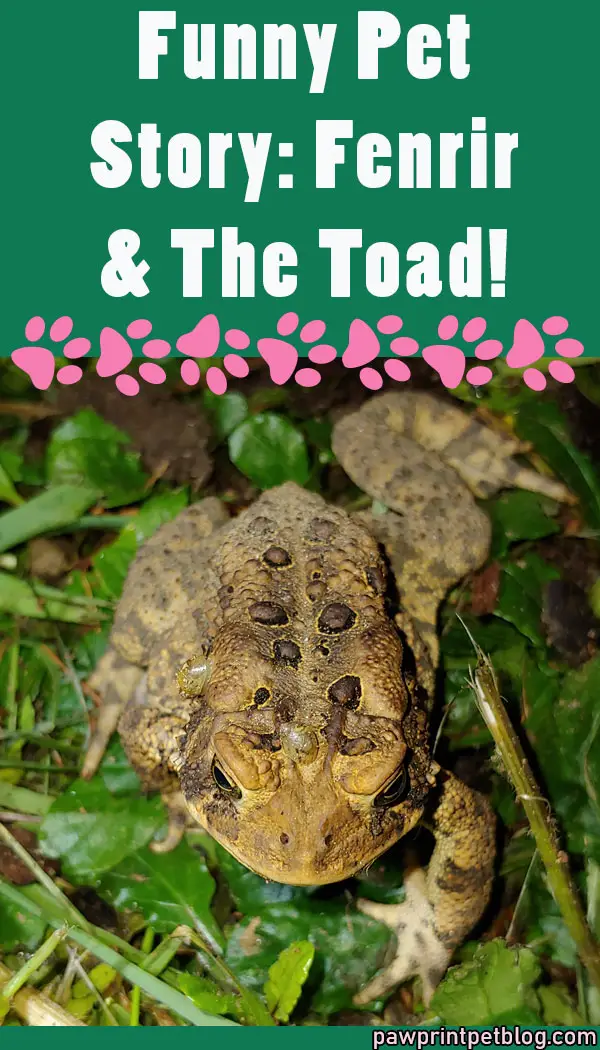
And Now Fenrir is Fondly Known As “Toad Bait”.

Ah, the joys of owning small dogs.  I imagine the poor toad was probably quite hungry, and maybe mistook Fenrir’s adorable little paw for some type of small, fuzzy animal?  Who would ever think that a toad would attempt to eat a dog!?  I know everyone is going to ask if I got a picture, but sadly I didn’t.  We were just outside for a quick potty break for the boys, I didn’t bring my phone/camera with me.  Plus it was dark and, like I mentioned above, the whole event lasted a couple of seconds tops.

An Important Note About Dogs & Toads:

Even though my intent in posting this was just to tell a silly story, I wanted to add that toads, some species more so than others, actually secret toxins onto their skin.  Most species of toads that are native to the US are relatively harmless, but can cause mild symptoms such as drooling, oral irritation, and vomiting if your dog decides to bite them back.  However, there are a few species, namely cane toads and Colorado river/Sonoran desert toads that can cause life threatening symptoms if your pet ingests (bites or licks) one.  Freak encounters aside, it’s best practice to keep your pet away from wildlife.

I guess, judging by Fen’s toad encounter, that toads don’t always feel the same way about staying away from domestic pets.  Thinking about the look on little Fen’s face as he calmly presented me with his toad bitten paw, coupled with how determined the toad was to swallow an entire dog whole, just makes me laugh every time I think about it.  Oh, toads don’t have teeth by the way, so little Fenrir was not harmed at all!  Maybe I should have written that sooner.

Comment below!  We always love to hear from our readers.  Did Fen’s….excuse me, Toad Bait’s, story make you laugh?  Have any of your pets ever had a silly freak encounter with a wild animal?

dog and toad