
Recent Posts

Common Garden Plants Can Be Toxic to Pets


plants toxic to pets

For the last couple of years, our gardens have been completely bombing.  This year, I tried to do some container gardening.  I thought that keeping my plants in containers close to the house would protect them.  Nope!  The deer still visited at some point and ate almost everything I was growing.  If you planted a garden this year, hopefully yours was a bit more successful, and you’ve been able to enjoy the fruits (vegetables and flowers too) of your labors.

If you’re anything like me, you probably share your fresh garden bounty with your pets.  Especially if, like me, you have a pet highly skilled in the art of begging (those eyes!).  Fresh fruits and vegetables can be delicious, low calorie snacks for many types of petsOpens in a new tab..  Home grown garden goodies are extra healthy if they were grown organically.  It’s important, though, to remember that not all types of fruits and veggies should be shared with your pet.  And while flowers are beautiful, some can be toxic.

The ASPCA has a great list of plants that are toxicOpens in a new tab. to dogs, cats, and/or horses.  If you have other types of pets, it’s usually pretty easy to find basic lists of toxic plants by searching online.  I wish I could include a list here, of either safe or dangerous garden plants.  But the list would be massive, and even then I’m sure there’d be lots of plants that I’d forget.

plants toxic to petsIf you don’t know for sure whether or not a plant is safe, it’s always best to avoid offering it to your pet until you can do more research.  If you don’t want to do the research yourself, your pet’s veterinarian should be able to help you.  Never assume that just because a plant is safe for humans, or even for other types of pets, that it will be safe for all species.  For example, small pets such as rabbits can safely enjoy grapes.  However, grapes are toxic to dogs.

Another thing to keep in mind is that just because part of a plant is safe, doesn’t mean that the entire plant is.  For example, like people, many dogs enjoy red tomatoes.  But did you know that green tomatoes, as well as the leaves and stems of tomato plants, contain a compound called tomatine?  Tomatine has anti-fungal properties that help to protect the tomato plants.  It is, however, toxic, and can cause gastrointestinal irritation, weakness, and ataxia (neurological symptoms) if ingested in large enough quantities.

I don’t think many pet owners would purposely feed their pets flowers from their garden.  It’s still important to note that many kinds of common garden flowers, such as Morning Glories, Tulips, and Daffodils, can be toxic to pets.  If you’d like to plant types of flowers that can be toxic to animals, it’s probably best to grow them in areas your pet can’t access.

Not all people realize that fruits and vegetables can actually contain a high amount of natural sugars.  Although humans can usually handle these sugars without any issues, this is not always true for pets.  Sugary fruits or vegetables can cause gastrointestinal distress in pets, if fed in excess.

Some types of pets, such as dogs, cannot digest raw plant matter well.  Your dog can still enjoy an occasional fruit/veggie snack, however if you want him/her to get more nutrition out of plant material you should try cooking or mashing/blending the food first.  This breaks down the plant’s cell walls, making them easier for carnivores to digest.

Comment below!  Is your garden successful this year?  What types of home grown produce do you like to share with your pet?
plants toxic to pets

The Dangers Of Cocoa Mulch


If you attempted a garden this year, I hope you had more luck than I did!  We’re still living in a rental house, so I’m limited on how much gardening I can actually do.  I attempted to set up a couple of outdoor container gardens, but it didn’t go so well.  My salad greens were growing nicely, until a deer paid us a visit one night.  I have a couple of tomatoe plants growing, but it’s mid August now and my plants are still on the small side.  I’m not holding out much hope that I’ll get many tomatoes.

Whether you have a massive garden and a green thumb, or just have a tiny bit of turf to tend, pet owners know that some plants can present health risks to our furry family members.  Seemingly unrelated, almost all pet owners also know all about the danger of chocolate.  Why am I talking about chocolate in a post that started off being about gardening?  Because of cocoa mulch, that’s why!  Don’t let your pet become a victim of the mulchacre (get it – mulch massacre?)!  The dangers that cocoa mulch can present to pets is no laughing matter.

What exactly is cocoa mulch, you ask?

cocoa mulch dogs
Photo Credit: Leslie Seaton. Licensed under the Creative Commons Attribution 2.0 Generic license.

And what did it ever do to me to make me want to write an anti-mulch post about it?  I’m glad you asked.

Cocoa mulch is, well, it’s mulch.  Mulch can be made of a verity of substances, but is generally a soil covering that gardeners use to help reduce weed growth, conserve soil moisture, improve the fertility of the soil, and sometimes just to look nice.  Sounds pretty harmless, right?  Most mulch is.  But cocoa mulch, as its name suggests, is made from cocoa bean hulls.  The hulls are a byproduct of the chocolate industry.  Unlike the cocoa bean itself, the hulls aren’t used to produce yummy delicious chocolate.

Normally I’m a huge proponent of recycling.  Using otherwise useless cocoa bean hulls as mulch sounds like an awesome idea, especially since I’m a huge chocolate fan.  Hey, all those bean hulls that are a result of my late night chocolate binges have to end up somewhere right?  But the ASPCAOpens in a new tab. and many other animal advocates warn against the use of cocoa mulch, especially if you have any four footed garbage disposals, otherwise known as hungry dogs, that frequent your yard.

Why is cocoa mulch dangerous for dogs?

Cocoa mulch is toxic to dogs for the same reason that chocolate is potentially deadly for dogs.  Or I should say, a chemical in chocolate can be deadly to dogs.  That chemical, theobromine, can also be present in cocoa hulls.

There’s been some debate on just how series of a risk using cocoa mulch around dogs can be.

The American Veterinary Medical Association posted an article back in 2006Opens in a new tab. suggesting that the mulch may not be quite as dangerous as some people make it out to be.  However, they still recommended that pet owners avoid using cocoa mulch.

But even if dogs don’t die from eating cocoa bean hull mulch, it can cause other symptoms of theobromine poisoning such as vomiting and muscle tremors.  Not fun, for dog or owner!  And according to popular myth busting website SnopesOpens in a new tab., there has been at least one confirmed dog death attributed to the consumption of cocoa mulch.

What do you think?  Is the evidence enough to convince you to avoid using cocoa mulch in your own garden?  My dog KitsuneOpens in a new tab. has a passion for food, and sometimes what he considers to be food is a far cry from what I consider eatable.  Even if he never eats enough cocoa mulch to do any damage, letting him gain a taste for chocolate is the last thing I want.  All the chocolate in this house belongs to me, and me alone!

cocoa mulch dogs

10 Tips to Help Your Dog Beat the Summer Heat


Is anyone else just ready for fall?  Just me?  I had so many fun things I wanted to accomplish this summer.  While I did complete many of them, the number of excessively hot days we’ve had this year made it hard for me to stay as active as I was hoping too.  The hot weather drains my energy, and multiple heat waves have meant that I’ve had to limit how much time I spend outside with my dogs.  Do you, and your dog, like the heat?

I recently posted Keeping Your Pet Cool – Summer Safety Tips,  but this post is going to be a bit more in depth.  Here are 10 easy ways you can help your dog beat the summer heat!

dog heatWater, and plenty of it:

Make sure your pet has access to fresh clean water at all times. It doesn’t take long for animals to start becoming dehydrated in the summer time. Make sure to bring water for your pets if you travel with them. A nice big bowl of cool water can be just as refreshing to a hot dog as it can be to a human.

Scheduling:

If you can, try to reschedule your dog’s day during the summer. Walking, running, or playing during the hottest parts of the day may become uncomfortable for both you and your pooch. Temperatures are usually the coolest early in the morning or later in the evening. These would be great times to get in your dogs daily walks, or to go to the park for a game of frisbee. It’s important that your dog continues to receive daily exercise, and planning it for the coolest parts of the day can make exercising more enjoyable for both you and your dog.

Location location location:

Remember to never leave your dog alone in your carOpens in a new tab.! Seems like common sense, right? Even a few minutes inside a hot car can harm your dog. Just as importantly, make sure you don’t leave your dog alone in other areas where he/she could overheat. That can include any type of structure without proper ventilation or air conditioning, such as a shed or garage.

Panting and paws:

Dogs sweat through their paws. Panting also helps cool them down when they are hot. Use your common sense, and don’t do anything that would prevent your dog from utilizing his/her natural cooling systems. If you must use a muzzle on your dog, opt for a basket muzzle that it is designed so that your dog can still open his/her mouth to pant, and that he/she can still drink through the muzzle. Pets may look cute in clothes, but summer is not the appropriate time to be dressing up your pet; it will only make them hotter.

Made in the shade:

When spending time outdoors with your pets, make sure they have a nice shady area to retreat too. Although your dog may love sunbathing, too much sun exposure can cause heat stroke. If you don’t have any naturally shaded areas in your yard, consider building your dog a shelter where he/she can go to get out of the sun.

dog heatRemember your grooming:

Don’t forget to groom your dog in the summer time, even if you have a short haired or non-shedding breed. A clean, well groomed coat will help to dissipate heat much better than dirty or matted fur. Some dogs will benefit from a nice summer hair cut.

Use sunscreen:

Yes there is such thing as dog sunscreen!Opens in a new tab. It only makes sense, since dogs can get sunburns. Most common areas for sunburn to occur include areas with less fur such as dog’s bellies, noses, or ears. If you have a dog with very short, light colored, or no hair then they may be more prone to getting sunburns. Invest in some doggy sunblock if you are planning on taking your dog out somewhere where they will be exposed to the sun for an extended period of time. Human sunscreen, however, can contain chemicals that can be toxic to pets, so make sure you choose a sunscreen that is dog safe.

Protect those paws:

Pavement can get very hot after a few hours of having the sun beat down on it. Dogs paws are sensitive to heat, so make sure to check the temperature of the asphalt before making your dog walk around on it. If the pavement is so hot that it is uncomfortable for you to stand on it in bare feet, than it’s going to also be uncomfortable for your dog.

dog heatCool treats:

You can help your dog keep cool and have fun at the same time in a number of different ways. If your dog likes the water, you could take him/her swimming, set up a kiddie pool to play in, or turn on the sprinkler. Playing in the water is a great way for your dog to get some exercise as well as cool off. You can also give your dogs some cool treatsOpens in a new tab. such as kongs stuffed with frozen yogurt or peanut butter, frozen veggies to chew on, or even something as simple as an ice cube to play withOpens in a new tab..

Stay informed:

Learn the signs of overheating, dehydration, and heat stroke, so that you can recognize when your dog is having a problem coping with the temperatures. Make sure you know your vet’s hours and phone number in case you need to call or bring your dog in. It’s also good to know the location of at least one emergency vet in case your dog is in distress and his/her normal vet is closed.

Remember that if the temperature outside is uncomfortable to you, it’s probably uncomfortable to your dog. The summer time can be a lot of fun for you and your best furry friend, as long as you make sure to be careful and stay cool.  Comment below!  How have you and your dog(s) been dealing with the heat this summer?  Do you have any tips for keeping your dog cool that I missed?

dog heat

Summertime Dangers: Blue-Green Algae (Cyanobacteria)


Despite now living in the great north, we’ve had to deal with some pretty intensely hot temperatures this summer.  Thanks, global warming.  We don’t have air conditioning, so we’ve had to find other ways of keeping cool on hot summer days.  Swimming, or otherwise spending time by the water, can be a fun way to keep cool with our dogs.  No matter how hot it gets, however, no one wants to swim in mucky green water!  Well, no human at least.  I’ll bet quite a few dogs would dive, much to their owner’s chagrin, right into a pond full of nasty green muck.  Why is it that so many dogs seem to enjoy playing in gross water outside, but yet despise bathsOpens in a new tab.?  It’s important to be aware that, requiring a bath aside, blue-green algae can be dangerous for our dogs.

Some types of algae are toxic!

Blue Green Algae dogs
Photo via Lamiot
Licensed under the Creative Commons Attribution-Share Alike 3.0

You might want to think twice before allowing your pet to play in water containing large amounts of algae, though.  Besides the after effect of having to wrestle your furry friend into the bath tub, some types of algae are actually toxic, and can be fatal for dogs (as well as humans).

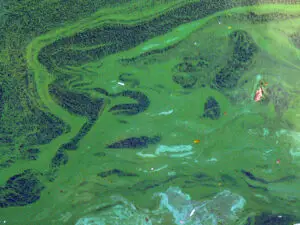
Cyanobacteria,  more commonly known as blue-green algae, is a type of photosynthetic bacteria.  Individual cyanobacteria cells cannot be seen by the naked eye, but when lots of the cells accumulate together it appears as a, for lack of a better term, muck.  The color of the algae can range from different shades of greens and blues to browns and reds.  It is sometimes described as looking like pea soup or paint, but can also appear in clumps that look more like foam or mats floating in the water.

But not all blue-green algae is toxic.

Keep in mind that not all blue-green algae is dangerousOpens in a new tab..  Some algae blooms are quite harmless, so much so that they are used as ingredients in natural food coloring and in dietary supplements.  However, it can be hard to distinguish between harmless and toxic algae blooms, and it’s not uncommon for natural blooms to contain a combination of toxic and non-toxic algae.  Most experts recommend to steer clear of water containing large amounts of algae, just to be on the safe side.

Blue-green algae blooms occur most commonly in slow moving, fresh bodies of water.

Blue Green Algae dogs
Hopefully no blue-green algae here!

Especially during the warmer months, algae blooms can appear and spread rather quickly.  Some cyanobacteria produce toxins (cyanotoxins) that are not only dangerous to humans, but to animals and plants as well.  Cyanotoxins are some of the most powerful naturally produced toxins, and they have been known to cause symptoms ranging from mild irritation, to neurological complications and death.

There is currently no known antidote for cyanotoxins.  Symptoms can begin as quickly as 15 minutes after exposure and can include more minor symptoms such as skin irritation, rashes, nose, throat, and eye irritation.  More severe symptoms can include vomiting, diarrhea, liver damage, lethargy, difficulty breathing, lack of coordination, convolutions, and nervous system damage.  Cyanotoxins can cause death, especially in smaller pets, sometimes as quickly as 30 minutes after exposure.

The best way to avoid cyanotoxin poisoning is to stay away from potentially contaminated waters.

Don’t let your dog play in, or drink water that contains algae blooms.  If you believe your dog has been exposed, don’t allow your dog to lick him/herself until all the algae has been removed from his/her fur.  Wash your pet as soon as possible.  If you believe your pet may have ingested some of the algae, contact your vet.  Your vet may recommend that you induce vomiting, or bring your pet in for supportive care.

Since, again, there is no known antidote for cyanotoxins, this is truly a case of prevention being the best medicine.

Blue Green Algae dogs

Get the Pet You Want


When I write “get the pet you want” what I really mean is “get the pet that, after doing your research, you decide is the best fit for you/your family” – but that doesn’t make for such a great blog title! 

I’ve had quite a few pets over the years.

get the pet you wantMy partner and I got Kitsune, our first dogOpens in a new tab., back in 2009.  Before Kit, for many years, I was a “rabbit person”.  I kept house rabbits, mostly rescues.  Over the years I shared my life with 5 different house bunnies (not all at the same time).  My last rabbit, Barnaby, passed away in 2017.  His exact age was unknown, since he was a rescue, but I had shared my life with him for 11 years.

I often think of my past bunnies, and miss them quite a bit.  After Barnaby, I decided to take a break from rabbits.  As much as I loved them, I was burnt out.  I volunteered quite a bit in rabbit rescue, where I had seen it all.  Almost all of my personal rabbits were rescues, and most of them came with health and/or behavioral issues.

Finding my first dog…

Before my partner and I got Kitsune, we talked a lot about what we were looking for in a dog.  My first inclination was to adopt because, well, adoption being the best option kind of gets drilled into you.  Especially when you’re involved in any kind of animal rescue, albeit with a different species.

I knew I wanted a papillonOpens in a new tab..  Papillons had been my favorite breed of dog since I was a kid, and we felt that a small, active, friendly dog would fit in perfectly to our outdoorsy, apartment lifeOpens in a new tab..  I spent SO long trying to find a papillon in a shelter near us.  I remember being so happy when I finally found one.  The papillon in question was a shy, adult female.  We had wanted a younger male.  I wanted a puppy that I could train and socialize myself, especially around small animals.  I still had rabbits at the time, and wanted a puppy I could raise around the rabbits, to train him/her to treat smaller animals with respect.  But c’est la vie, right?  It had taken me months to find a papillon in rescue, so I felt like I couldn’t really afford to be picky.

Alas, it wasn’t to be.  Despite being a more than dedicated pet owner, who had worked in rabbit rescue for many years and had a biology degree, the rescue decided to deny my adoption application.  I was one year younger than their required age to adopt.  Apparently, I hadn’t yet attained the magical age of responsibility.

My dogs came from reputable breeders.

get the pet you want
My dream puppy, 13 years later!

I was heartbroken.  What were the chances that I was going to find a papillon, local to me, in rescue again anytime soon?  Let alone ideally either a puppy, or one that was already ok around small animals.  And would I get my hopes up, only to have them dashed again?  We were young, lived in an apartment, and didn’t have a fenced in yard.  A trifecta that, apparently, to a lot of recues made us horrible adoption candidates.

I did a lot of soul searching, and a lot of research.  I decided to reach out to reputable papillon breeders and, long story shorter, found my dream puppy – Kitsune!  He was everything I was looking for in a dog, and then some!

Finding a new pet is not “one size fits all”.

Being very involved in the pet community for quite awhile now, the argument of rescues verses breeders is a reoccurring point of discussion.  “Adopt don’t shop” is a mantra I see often, as if those of us buying animals from reputable breeders liken the experience of “shopping” for a living being, a new member of our family, to purchasing a pair of socks or a new sweater.  Going through a reputable breeder is nothing like shopping, by the way!

I’ve been asked many times before where my loyalties lie when it comes to obtaining a pet, and I’ve always said pretty much the same thing.  Get the pet you want.  The pet that is the best fit for you and your family.  Get the pet that you can handle for the entirety of its life.

For some people that pet is going to be a rescue pet – and that’s awesome!  For other people that pet is going to come from a reputable, well researched, breeder – and that’s ok too!

I’ve always been a huge proponent of doing lots (and lots and lots) of research before adding a new pet to your family.  Getting the right pet is so important!  It could mean the difference between being able to provide that animal with an awesome home for its whole life, or having to give him/her up when you realize that they weren’t the best fit for you.  If more people put more thought into always selecting animals that fit well into their lives, less pets would end up homeless in shelters.  At the end of the day I would think/hope that more animals in happy, lifelong, appropriate homes would be something all animal lovers could get behind.

get the pet you want

What is Flea Allergy Dermatitis?


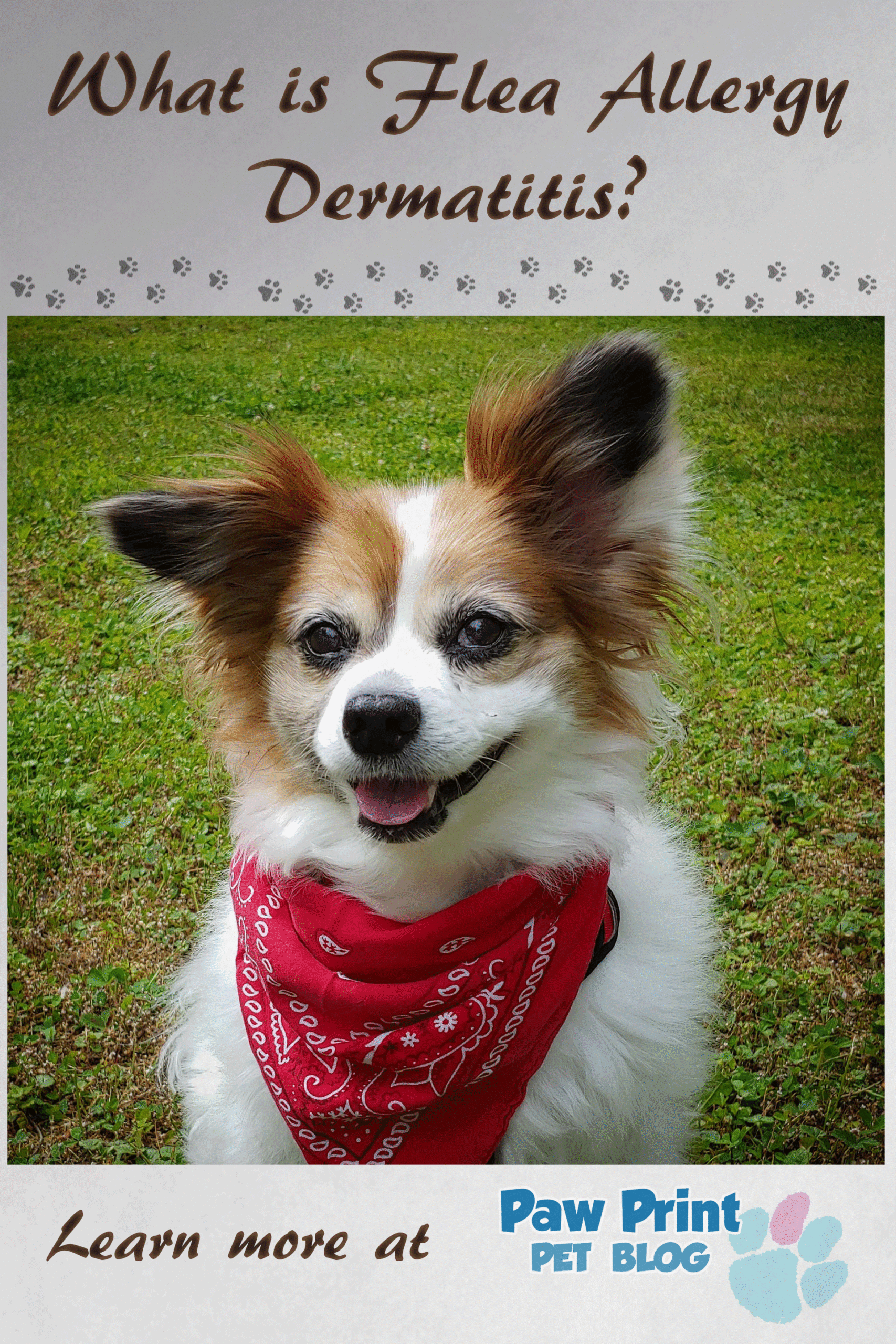
There’s been a lot of hype going around on social media about the potential dangers of dog flea and tick preventatives.  This has always been such a hard topic for me.  I’m the type of person who likes to take as natural an approach as possible with my dogs.  I don’t like the idea of exposing them to unnecessary chemicals, especially ones with known (potential) side effects.  However, my senior papillon, KitsuneOpens in a new tab., suffers from flea allergy dermatitis.  If he gets so much as a single flea bite, it will often times develop into a hot spot.  Flea allergy dermatitis, and the resulting hot spots, make Kit so miserable that I do whatever I can to prevent them, including use flea (and tick) preventatives from our vet.

What is flea allergy dermatitis?

Flea Allergy Dermatitis

Very simply, flea allergy dermatitis (FAD) is a hypersensitivity to flea bites.  Dogs with FAD are allergic to flea saliva, which is injected into their skin when a flea bites them.  

What are the symptoms of flea allergy dermatitis?

Symptoms of FAD can occur as soon as 15 minutes after a flea bites an affected dog.  In some dogs, however, more serious symptoms can take 24-48 hours to develop.  Symptoms of  flea allergy dermatitis in dogs can include…

  • Intense itching, which usually results in excess scratching, licking, and chewing at affected areas.
  • General discomfort and restlessness.
  • Hair loss.
  • Red, inflamed, darkened, and/or thickened skin.
  • Hot spots.
  • Wounds caused by biting and scratching, usually focused around the back, belly, thighs, and the base of the tail.

What are hot spots?

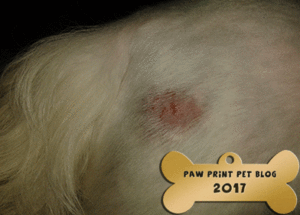
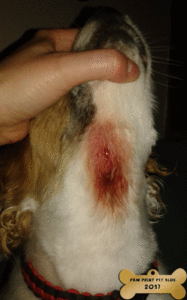
dog hot spotsMy poor Kitsune commonly develops hot spots as a result of his flea allergy dermatitis.
Hot spots are also known as acute moist dermatitis.  They are areas of very inflamed, irritated, red skin.  Hot spots are most commonly found on dog’s faces, necks, legs, and hips, although they can occur anywhere.  They may bleed and become infected, especially if your dog is prone to licking, biting, or scratching at them.  Hot spots are commonly caused by parasites, such as fleas, or any other condition that causes your pet to bite, scratch, and lick at themselves. 

Unfortunately, my Kitsune always has a hard time leaving his hot spots alone.  He bites (if he can reach) and scratches at them until they become a horrible bloody mess.  I often have to resort to putting a cone on Kitsune to get him to leave his hot spots alone long enough for them to heal.

What is the treatment for flea allergy dermatitis, and resulting hot spots?

With my own dog, an instance of FAD, and any resulting hot spots, often time means the cone of shame makes an appearance.  Luckily, these days, there are quite a few types of comfort conesOpens in a new tab. available for dogs.  These are a big improvement on the ugly, uncomfortable plastic cones of old.

Talk to your vet if you suspect your dog is suffering from flea allergy dermatitis.  Many vets will prescribe medications such as corticosteroids or antihistamines to help make your dog more comfortable.  Additional medications may be required if your dog’s symptoms include a bacterial or yeast infection of the skin.

The best cure is prevention!

Flea Allergy DermatitisHere’s where we circle back to flea and tick prevention.  I get being cautious about using medications with our pets.  I would absolutely hate for one of my little ones to suffer a negative side effect from their flea/tick prevention.  But you know what I also hate?  Watching my dogs suffer when I know there’s a way for me to prevent that suffering.  And if you can’t tell by the gross photos of Kit’s hot spots above, flea allergy dermatitis and the resulting hot spots very much do cause Kitsune suffering.

Preventing fleas in the first place is the best way to deal with flea allergy dermatitis.  You can talk to your vet about what flea preventative is best for your individual dog.

Unfortunately, I never had amazing luck using only natural products to prevent fleas and ticks.  I’ve tried quite a few natural products over the years, but never found our “holy grail” natural flea/tick product.  Between Kitsune’s issues with FAD, and my younger dog, FenrirOpens in a new tab., already having Lyme disease, fleas and ticks are just not something I feel like I can afford to mess around with anymore.  Both of my dogs are on flea/tick preventatives from our vet.

Other things you can do to help…

Kit is a high maintenance dog, especially in the summertime.  I bathe him oftenOpens in a new tab. to clean off any allergens that may have gotten onto his fur.  I try to brush him daily, but more realistically probably get it done a few times a week, and I make sure to stay on top of his flea preventative.  He gets high quality home prepared food and I supplement his diet with fish oil for his skin and fur.  When his symptoms get bad, especially when/if he develops hot spots, he requires treatment that is usually a combination of topical and oral meds from the vet.  Sometimes we have to resort to putting booties or a cone on him to prevent him from hurting himself.

In addition to all that, I also make sure to keep our house as clean as possible.  I vacuum the floors daily to eliminate allergens and to ensure that fleas don’t have anywhere to hide out.  All our bedding gets washed frequently and furniture gets vacuumed/cleaned at least once a week.

Thankfully, though, it’s been years since my dog has had a FAD flare!

I guess what I’ve been doing has been working!  The pictures I used of Kitsune with hot spots and FAD were taken back in 2017.  I can’t even remember when Kit last had fleas.  It’s been years!  I’d like to credit his flea prevention, and my efforts to keep him clean and flea free.  But, to be honest, we also moved out of the city a few years ago, and ever since I don’t think I’ve seen a single flea on either of my two dogs.  Of course country dogs can encounter fleas too, so I won’t be stopping my efforts to keep Kitsune comfortable and flea free.

I’m happy to do whatever it takes to keep Kit as comfortable as possible!

Do you have a pet that suffers from flea allergy dermatitis?  What are some things you’ve found that help keep your pet more comfortable?  Comment below!

Flea Allergy Dermatitis