Recent Posts

Saving Shelter Pets is as Easy as Walking your Dog: Wooftrax Review


Do you use any pet-related apps?  For many years now, one of my favorite dog-related apps has been Wooftrax (formally Walk For A Dog)Opens in a new tab..  Available for both Android and iPhones, Wooftrax is an app that makes helping to save the lives of shelter pets fun!  I’ve had this app installed on my various phones now for over 7 years!

WooftraxWooftrax makes helping shelter pets as easy, and fun, as walking your dog!  The app uses GPS through Wi-Fi or a cell signal to track the distance you walk, your miles per hour, how long you spend walking, and even shows a map of your route!  It’s awesome for pet owners who may be trying to maintain an exercise routine and want to keep track of their walking stats.  But what really makes this app awesome is the fact that it lets you select a shelter to walk for.  Your selected shelter receives donations for each mile you walk!

The app makes money by showing ads and from sponsors.  The more you walk, the more money you earn for your selected shelter.  Kitsune, Fenrir, and I are currently walking for PRONE – Papillon Rescue of the North East, a papillon rescue that we recently featured on our list of US-based Papillon rescuesOpens in a new tab..  The list of shelters you can walk for is extensive.  You can select any shelter from the list, even if they’re not local to you.

Wooftrax now lets you create walking groups, and participate in challenges.  Those are features it didn’t have when I first joined.  As of the time I’m writing this, the ‘Winter Walking Challenge’ is currently running.  You can join the challenge to earn an extra donation for your selected charity.  You can also set your own daily goals, like how many walks you want to take per day, and how many miles you want to walk.

This app is awesome if you have a dog!  You can use the app during any walk, no matter the duration.  Since my dog, Kitsune, just recently recovered from IVDD our walks have been on the puny side.  We’re working on rebuilding Kit’s muscles, so haven’t been walking much more than 15 – 20 minutes with him a day.  But that’s ok!  Even short walks add up over time.

When we moved into our current rental house, I was worried that Wooftrax wouldn’t work for us anymore.  Our cell connection here is super spotty.  Because of this, Wooftrax doesn’t always tack our walks as accurately as it did back when we lived in the big city.  But it works well enough that we get a pretty good representation of our route.

With the new year right around the corner, why not make a resolution to walk with your dog(s) more?  Spending time outdoors with my two dogs is my favorite form of exercise.  All the more awesome that I can use the time we spend walking together helping shelter pets too!

Wooftrax

Titer Tests


What are titer tests?  Are they appropriate for your pet?  Vaccines, whether for people or our pets, have always been a hot-button issue.  I have spent a fair amount of time researching to decide what vaccinations I feel are necessary for my two dogs.  Of course no one wants their pet to contract potentially deadly diseases, especially if there is a way to protect against them!  But vaccinations, unfortunately, do come with some risks too.  I’ve always been on the side of appropriately, but not over, vaccinating my dogs for diseases that are potentially deadly and/or common due to where we live and our lifestyle.

Are We Vaccinating too Often?

This file is licensed under the Creative Commons Attribution-Share Alike 4.0 International license. Photo Credit: Whispyhistory.

It was common for many years for veterinarians to recommend vaccinating pets yearly.  But studies are now starting to show that many common vaccinations actually provide pets with disease protection for much longer.  This leaves many pet owners wondering if vaccinating so frequently is necessary.  For pet owners who want to do what they can to ensure their pets are protected against disease, but who also don’t want to needlessly over-vaccinate, having your vet perform yearly titer tests is an alternate option.

What are Titer tests?

To put it simply, a titer (pronounced tight-er) test is a blood test.  Your pet’s veterinarian will draw blood from your pet to determine if your pet currently has antibodies against certain diseases.  Vets commonly report results from titer tests in terms such as strong and weak.  A strong titer result means that your pet has high numbers of antibodies against the disease in question.  A weak titer result means that, while your pet does have antibodies present, they are not present in high numbers. 

Your veterinarian should be able to explain your pet’s results and recommend a course of action.  A weak titer result doesn’t necessarily mean that your pet needs to be re-vaccinated.  However, if titer testing shows that your pet does not have antibodies present at all, depending on your situation it is probably a good idea to re-vaccinate your pet.

What Vaccinations Can Titers be Used For?

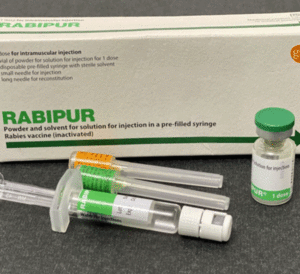
It’s important to note that, although you can run titer tests for rabies, US laws still require that your pet be vaccinated against rabies.  Some vets, groomers, dog sitters, etc. will accept titer results in lieu of regular vaccinations, however not all do.

Veterinarians commonly run titers to check for immunity against the core diseases – parvo, adenovirus, and distemper.  When non-core diseases come into question (ex. kennel cough, Lyme, LeptospirosisOpens in a new tab., etc.) it’s usually recommended that, rather than run titers, the dogs lifestyle, health, and vaccine tolerance be taken into account.  This is because, for the core vaccinations, the titer numbers required to protect your pet from infection have been established.  This means that your vet can tell, by looking at your pet’s titer results, whether or not he or she is still fully protected against these core diseases.  This is not yet true for other vaccines.

Current AHAA Recommendations

AHAA stands for The American Animal Hospital Association.  Vet clinics that are AHAA accredited will follow AHAA care standards.  The current AHAA vaccination standards for dogsOpens in a new tab. recommends boosters every 3 years for the core vaccines (distemper, adenovirus, distemper).  Rabies vaccinations should be administered as required by law.  In many states this is also once every 3 years after the initial puppy vaccine.  That’s a big improvement over the days of old, when all vaccines were recommended to be given yearly.

AHAA recommends that titers be used for dogsOpens in a new tab. who have a history of vaccine reactions, vaccine related immune issues, or whose owners are opposed to frequent revaccination.  Many vaccine directions warn against vaccinating dogs who are ill.  Your vet may consider running titer tests if your dog is sick or elderly.

Do I Titer Test My Dogs?

Titer Tests

Thankfully neither of my dogs have ever experienced vaccine reactions.  I take Kit and Fen to an AHAA accredited vet and have been vaccinating them according to the current AHAA standards.  However, my Kitsune will be turning 14 later this month and has been experiencing a couple of health issue (unrelated to vaccines) over the past couple of months.  He’s due to receive his core vaccine booster this summer.  At that time I’ll be discussing whether we should opt to run titers rather than vaccinating him with our veterinarian.

Vaccinations save lives, but I don’t like the idea of over vaccinating my pets.  I appreciate that titer testing is available for owners who want to stay on top of their pets’ immunity status without having to blindly vaccine frequently.  While the 3 year boosters for core vaccines are certainly an improvement over getting them done yearly, there seems to be building evidence that even once every 3 years is overkill when it comes to the core vaccines.

What do you think?  Comment below!  Have you ever had your veterinarian run a titer test on your dog?  Would you consider it in the future?

Titer Tests 101


Kitsune’s Turmeric Treats


This post contains the simple recipe for turmeric treats that I use to supplement my senior dog, Kitsune! 

I recently wrote a couple of blog posts about Turmeric, including this one about the benefits of feeding turmeric to dogsOpens in a new tab., and this one about how to make golden paste for dogsOpens in a new tab..  I mentioned in our golden paste post that I was giving my senior papillon, KitsuneOpens in a new tab., turmeric but I had to stop recently when he was put on steroids to help treat IVDD.  Thankfully he’s been off of steroids for over a month now.  Kit had (yet another) follow-up visit with his vet recently.  We were given the go-ahead to start supplementing him with turmeric again.  I give it to him to help with his arthritis and mild GI issues.

Why Turmeric Treats?

When I first decided to try turmeric for Kitsune I started by mixing it into his regular food.  Kit is OBSESSED with food.  While Kit was still eating his food with the turmeric mixed in, I could tell he wasn’t as excited about his food as he usually is.  Not wanting to decrease his enthusiasm for his regular meals, I started making him these very simple turmeric treats instead.

I start out by making Golden Paste.

Here’s my more in-depth post about that process.  On its own, turmeric is hard for dogs’ bodies to absorb.  When it’s mixed with black pepper and a source of fat (I use coconut oil), it becomes much more bioavailable.

Just a quick note – Some of the photos in this post are from 2016.  However, this post text was last updated on 12/6 /2022. 

Here’s a quick rundown of the ingredients in golden paste:

  • 1/2 cup high-quality turmeric powder
  • 1 cup of water
  • 1/4 cup coconut oil
  • 1 1/2 – 2 teaspoons ground black pepper
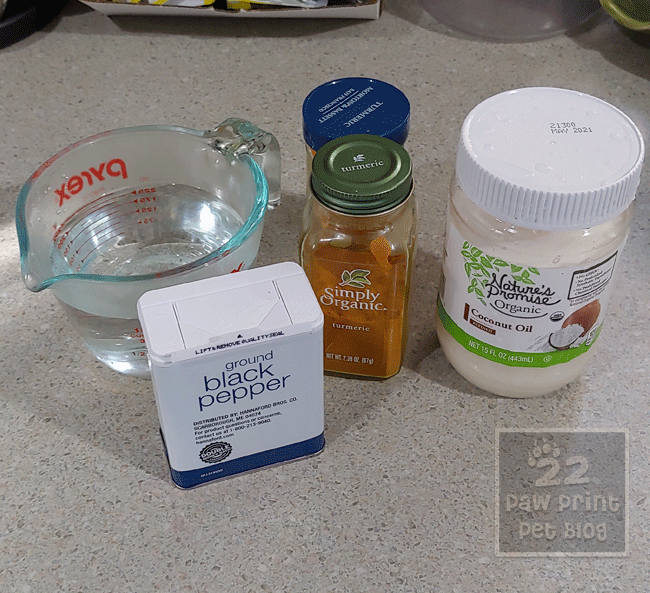
turmeric treats

Mix all the ingredients together and put over low heat.  I don’t set a timer for my Golden Paste, but instead mix continuously until I get the desired texture.  It shouldn’t take too long, a few minutes or so, for the mixture to start becoming thicker and looking more uniform.

golden paste

Time to make Turmeric Treats!

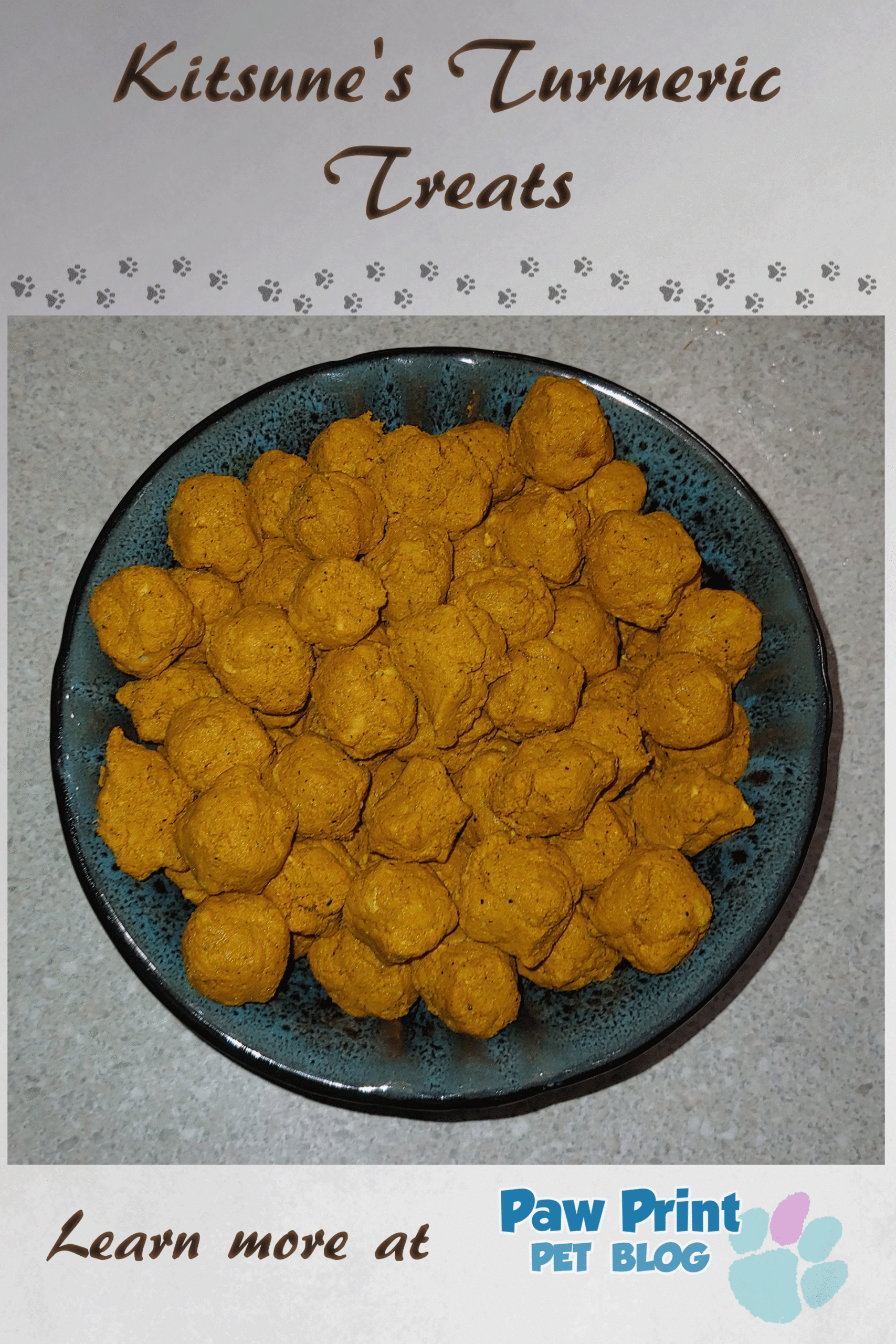
The treats I make for Kit are very simple.  I just use equal parts Golden Paste and ground beef.  I usually use a half a cup of each.  Any extra Golden Paste can be stored in the refrigerator for up to 2 weeks.  It can be kept in the freezer for up to 6 months.

5

I use a blender to mix the Golden Paste and beef together.  Hand mixing would be fine too.  For dosing accuracy you want to make sure the ingredients are mixed together very well.  The dosage of Golden Paste that I use for Kitsune is 1/4 a teaspoon per 10 lbs.  Kitsune is 20 lbs so he needs 1/2 a teaspoon of Golden Paste a day.  The effects of turmeric don’t last super long, as it leaves the body quickly.  Because of this, I like to split Kit’s dosage in half.  I give him 1/4th of a teaspoon with his breakfast, and the other 1/4th with his dinner.

For Kit’s treats, after they are well mixed, I use measuring spoons to make 1/2 teaspoon balls.  As long as you mixed well each 1/2 tsp ball will contain 1/4 a teaspoon of Golden Paste and 1/4 a teaspoon of ground beef.  So Kit, at 20 lbs, gets two of his turmeric treats per day.

A Note on Dosage

The standard dosage of 1/4th of a teaspoon of turmeric per 10lbs of body weight has always worked well for Kitsune.  Turmeric can sometimes cause stomach upset, especially when first offered.  It’s a good idea to introduce it into your dog’s diet slowly.  With Kitsune, I started out with just 1/4th a teaspoon a day.  I then increased to the full 1/2 of a teaspoon per day (because Kit weighs 20 lbs).  If your dog has a sensitive stomach, consider starting with an even lower dose.

Signs that may indicated that you’re giving your dog too much turmeric, or that you started with too high of a dose for them, can include diarrhea, upset stomach, or constipation.  If your dog displays any of these symptoms it’s a good idea to back off a bit and decrease your dog’s dosage.  Although 1/4th of a teaspoon per every 10lbs is the typical turmeric dosage, finding the “perfect” dose for your dog may take a bit of trial and error.

Turmeric does have some health contradictions, so it’s always a good idea to discus any new supplements with your vet.  Notably, turmeric should not be offered to dogs who are on certain medications, including anti-inflammatories and diabetes medications.  It is also not recommended for dogs on blood thinners or who have scheduled surgeries.  This is because turmeric can act as a natural blood thinner.  Turmeric, especially in too high of a dose, can cause GI upset.  It should also be avoided for dogs who are prone to developing kidney stones.

Raw Verses Cooked

I normally don’t cook our turmeric treats.  Once I create the 1/2 tsp balls I set them on a baking sheet in the freezer until they freeze solid.  Once they freeze, I move them to a Tupperware container or Ziplock bag and keep them in the freezer.

Since I know not everyone is comfortable feeding raw meat to their dogs, I decided to try cooking some of the turmeric balls to see what happened.  I just placed the 1/2 tsp balls on a clean baking sheet (no need to add oil to prevent sticking since the treats already contain a good amount of coconut oil) and cooked them at low heat (150*F) for 20 minutes.  The treats came out a nice golden brown color, and stayed pretty soft.  Here’s a picture to show the difference between the treats I froze and the ones I baked.

6

The frozen treats look bigger because the baked treats did loose some of their liquid (including the coconut oil) while cooking.  There was quite a bit of coconut oil on the bottom of my baking sheet when the treats were done.  This leads me to believe that if you are concerned about keeping the proportions of coconut oil stable the frozen treats would be better.

Does Cooking Turmeric impact it’s Effectiveness?

I did a bit of research on whether or not cooking turmeric in this way decreases it’s benefits at all and came across this articleOpens in a new tab..  It’s rather long but points to note are that the oil and water used to create Golden Paste help to protect the active ingredients in turmeric from degrading.  While cooking has been shown to break down the active ingredients in Golden Paste, the good news is that the particles the ingredients are broken down into work just as well, if not better, than the original ingredients.  Take a look at the article I linked to above for more information.  It explains this concept a lot better than I do!

Turmeric Treats Storage

Whether I bake them or keep them raw, I store Kitsune’s turmeric treats in the freezer.  No need to thaw, when I feed Kit I just take a treat out of the freezer and add it to his dish.  Turmeric is safe to store frozen for up to 6 months.  That’s decreased to just 2 weeks if it’s stored in the refrigerator.  However, since these treats also contain meat I wouldn’t personally feel comfortable storing  them in the refrigerator for more than a few days.  If your dog doesn’t like to eat these treats frozen, you could still store them in the freezer and just take out a couple at a time to thaw before offering them to your furry best friend.

Kit loves his daily meat balls!

Simple as they are, Kitsune eats these turmeric treats readily.  When I first made them I was worried that he wouldn’t like them.  Like I wrote above, Kit didn’t seem to like it when I mixed turmeric in with his regular food.  For whatever reason, though, he really likes these treats!

If you try using turmeric for your dog, my last suggestion would be to give it some time before you evaluate whether or not it’s working.  When I first started using turmeric for Kitsune, it took about a week before I could start to tell that it was helping him.

Comment below!  Have you ever tried turmeric for any of your pets?  Did you see any benefits from it?  How do you feed it to your pets?

Please remember to talk to your pet’s vet before starting any new supplement, especially if your furry friend is experiencing any health issues.

turmeric treats

Tips for Keeping Your Pets Calm During Fireworks


I feel like this may seem like a weird time of the year to be posting about fireworks.  However, in many places, people celebrate the new year with fireworks.  It was really common where we used to live, just outside of NYC.  In fact, we used to be able to watch new years eve firework displays from our apartment window.  Now we live in a state where consumer fireworks are legal.  So, as you can imagine, hearing fireworks go off in our neighborhood, especially around holidays, is relatively common.  Unfortunately, as beautiful as they are, fireworks can be really frightening for our pets.  This post will include tips for helping to keep your pets calm during fireworks.

Bring Pets Indoors:

Keeping your pets safely indoors will reduce the risk of them running off in fear.  Even if your pet wouldn’t normally leave your yard, he/she may find a way to escape if frightened enough.  It’s also important to keep in mind that inconsiderate partygoers in your area may pester, or even harm, pets left outdoors on their own.

pets calm fireworksExercise Pets During Daylight Hours:

Make sure your pet gets plenty of exercise before fireworks are expected.  Exercise can have a calming effect.  Pets who don’t have a ton of excess energy are usually less prone to panic.

Reduce Outside Noise:

If possible, close your windows, shades, and doors.  Keeping your home closed up should help reduce loud sounds, and will also hide flashing lights and reduce strange odors.

Create Familiar Sounds:

Help to mask the sound of fireworks by playing sounds that are familiar to your pets.  This could be as simple as turning on the TV or radio.  Play soothing music or something that your pet is already used too.

pets calm fireworksDistraction:

If you are staying in with your pet, you can try distracting him/her with toys or treats.

Safe Hiding Places:

Many types of pets will feel more comfortable if they have a safe place to hide when they are frightened.  Let your pet hide if she/he wants too.  Trying to remove your pet from their hiding place will probably stress him/her out even more.  Provide your pet with a safe place to hide, such as a crate, under a blanket, etc., and only remove pets from hiding if they hide somewhere unsafe.

Stay with Your Pet:

For some animals, there is nothing that comforts them more than being with their human.  If you can, stay home with your pet when fireworks are expected.

Set a Good Example:

Try to remain calm even if your pet is stressed.  Pets can sense their owner’s moods and if you remain calm it may help your pet calm down as well.

Products that May Be Helpful:

If you know that your pet is extremely fearful around loud noises, there are a few products designed to help keep pets calm.  Thundershirts Opens in a new tab.are designed to help pets with anxiety.  Rescue Remedy Opens in a new tab.is suppose to help stressed out pets as well.  If your pet is very fearful, and you are worried that he may hurt himself, contact your veterinarian for advice.  Some vets may prescribe sedatives to help keep your pet calm during times of extreme stress.

Is your pet afraid of fireworks?  Do you have any additional tips for keeping pets calm during potentially stressful holiday celebrations?  Comment below! 

pets calm fireworks


Cleaning Up After Multiple Dogs


Today I’m going to write about how I keep my house squeaky clean, despite sharing it with my two dogs, KitsuneOpens in a new tab. and FenrirOpens in a new tab..  I know that the messes they make can be one of the major downsides people find in keeping pets.  I can understand why.  Clean homes are just more comfortable!  And dogs, especially if you don’t figure out a good cleaning schedule that works for you, can be quite messy creatures to live with.

Finding Time with a Busy Schedule

I think I wrote recently about how busy I get especially around this time of the year.  For a while now I’ve been working on a couple of different projects for work, all of which get very busy during the lead-up to the fall/winter holidays.  I’ve been taking on as many extra hours at work as I can.  For the last couple of weeks especially I’ve found it a bit of a struggle to keep up with my writing/blogging after spending so much time in front of the computer screen for work.  Of course, besides boring stuff like working and blogging, I always make sure I spend time caring for my puppy loves and my partner.  Spending dedicated time with them each day makes my heart so happy.
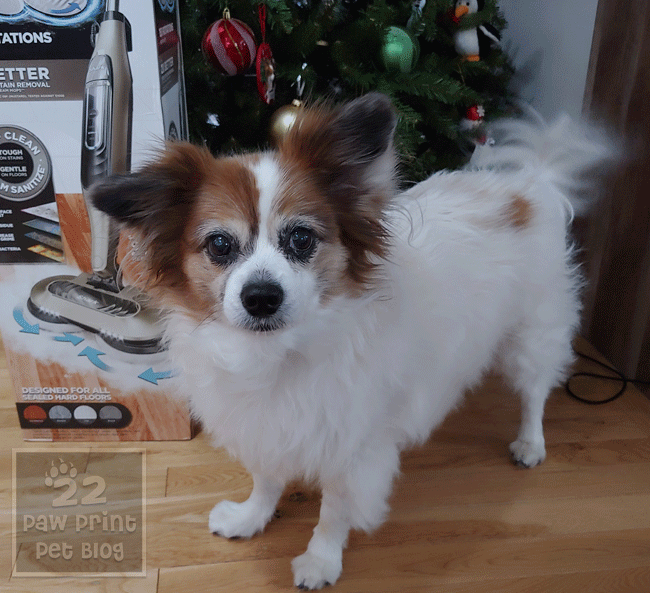

With all that, who has time to clean!?  But cleaning, I guess, is important too.  I always want to make sure my little pack can feel safe and comfortable in our home.  A big part of that is keeping it nice and clean.

I’ve found, especially lately, that I really have to make sure to set some time aside each week to clean.  When I don’t plan it into my schedule, I tend to get too preoccupied with doing other things while neglecting the cleaning.  Since the busy season started with work, I’ve been making a point to set a good chunk of time aside during the weekend to get some deep cleaning done.

Checklists Can Help!

It may sound lame, but I actually write myself out a “To Do” list at the beginning of each week.  It’s not only for cleaning tasks, but I write down all the rooms of my house on the list.  For some people, checking completed tasks on a list can feel satisfying, and making yourself a To Do list can help motivate you to complete tasks that you otherwise might be likely to let slide.

cleaning dogs
Check out that tail wag! <3 Kit is the cutest.

Whether it Needs it Or Not!

With multiple pets, I think the key (at least for me) is to clean things before they get to the point of really needing it!

One of my dogs in particular, Fenrir, sheds quite a bit.  I hate when I slack off on the cleaning for so long that our house gets covered in doggy fur tumbleweeds.  Cleaning up after a heavily shedding dog, especially when they’re blowing their coats, can feel a bit like trying to brush your teeth while eating Oreos!  It can certainly feel like a futile task at times.  But I find it’s much easier to vacuum, and just generally keep the house clean, when I tackle smaller messes verses letting the fur fly and waiting for the house to get really messy before I attempt to tackle it.

Cleaning this way sometimes feel pointless, because it means I’m often deep cleaning rooms that don’t feel particularly messy in the first place.  But it usually means that I get to spend less time cleaning in general.  And the house stays at a more constant level of cleanliness rather than only feeling really comfortable right after a big cleaning day.

Keep Those Dirty Dogs Clean!

cleaning dogsOne thing that I’ve always felt made a huge difference in how clean my house stays is the fact that I groom my two dogs often!  Our grooming/bath schedule has morphed a bit throughout the years.  I currently bathe Kit and Fen each every other week.  Did you know that as long as you are using high quality products, bathing your dog frequently should not dry out their fur or skinOpens in a new tab.?  Besides baths, I brush my dogs often, at least a few times a week.  For Fen especially, it really cuts down on how much fur he’s shedding around the house.

Funny fact!  When I was a kid, I guess I must have met quite a few stinky dogs.  I didn’t think I was a “dog person” because I didn’t like how they smelled.  I also didn’t like petting dogs and feeling like my hands were dirty/greasy after.  I’m proud to say that there are no stinky dogs in the Paw Pack house!  And because my dogs don’t smell  like stinky dogs, neither does my home!

Besides my dogs themselves, I also make sure to keep their bedding and toys clean too.  Their toys I probably only clean once every few months, or as needed.  Their bedding, though, I usually throw in the wash once or twice a month.

Natural is Best

When cleaning, especially surfaces that my dogs have access too, I like to use mostly natural cleaners.  Vinegar and baking soda can make great, pet safe, cleaners and bonus points, they’re cheap too.  A good vacuum, rug cleaner, and steam mop are worth their weight in gold in a pet household!

Comment below!  How many pets do you have, and what’s your pet friendly cleaning routine like?  Do you have any tips I didn’t mention for how you keep your house clean with pets?

cleaning dogs

Girl Vs. Boy Dogs: Does it Matter?


When it comes to your dogs, does their sex matter?  Do you prefer one over another?  If so, why?

Boys Rule?

For most of the time my partner and I have kept pets together, we’ve seemed to gravitate more towards males.  Our current two dogs, Kitsune the papillonOpens in a new tab. and Fenrir the Alaskan Klee KaiOpens in a new tab., are both boys.

dogs sex matter

When I used to keep house rabbits, I initially adopted males because I had heard that females were more prone to moodiness and aggression.  However, when I did eventually adopt my first ever female rabbit, a little back and white Holland lop named Berry, I was surprised by how sweet she was.  Berry dispelled any myths I may have held about female rabbits, and I eventually went on to adopt another female, Poppet, who was without a doubt the sweetest, friendliest rabbit I had ever met!

But we still went on to select two boys when it came to getting our dogs!

There are so many other factors to take into account!

Behavior trends based on an animal’s sex seem to be just that – trends.  They don’t mean that all members of a certain sex will all behave the same way.  Female dogs are often generalized as being more aloof than their male counterparts.  But, like with my rabbit example above, that isn’t always the case.  For every story you hear about an aloof, independent female dog, you’ll hear another about one who is super snuggly and obsessed with her people.  It seems, big surprise (note the sarcasm there) that an animal’s personality is based on a lot more than just their sex.

But Sometimes, Sex Does Matter

That doesn’t mean that sex differences can always be written off completely.  A big issue that comes to mind is same-sex aggression in dogs.  Seen more often between two female dogs, same-sex aggression is exactly what it sounds like.  Oftentimes, if you are thinking about adopting a second dog, your best option will be to get one that is the opposite sex of your current dog.  Aggression is documented more often between two female, or two male, dogs than it is between male-female pairs.

However, you may have a reason to select a specific sex such as, for example, your current male dog being unneutered.  With two male dogs, whether they are neutered or intact, you wouldn’t have to worry about any accidental puppies.  There are sometimes some physical differences between males and females that make people favor one sex over the other.  Female dogs tend to be, on average, smaller than males.

Or Maybe Girls Rule?

There are some other physical differences that can cause people to prefer one sex over the other.  Males of many species tend to have more noticeable…well, you get the idea.  Many people don’t like that male dogs mark, even if they keep their marking activities outdoors.  Males, especially when left intact, are also more likely to display unwanted sexual behaviors.  However, humping in many species is not always solely a sexual behavior.  It can also be used to display dominance, for example, and is not a super unusual behavior even in fixed pets.

With female dogs, of course, you do have to deal with them going into heat until they are spayed.

It all Comes Down to Personal Preference

Some people just seem to prefer one sex over another for no discernible reason.  I don’t have anything against female dogs,  I just prefer keeping males.  I don’t know whether I can entirely explain why.  It’s just personal preference, I suppose.  I don’t write off the chance that I’ll someday share my life with a female dog.  But when given the option I feel like I’ll always be more likely to select males.  Although I admit it would be fun to have an excuse to buy pink, girly dog supplies!

What do you think?  Feel free to comment below!  If you prefer to keep pets of one sex over the other, do you have a specific reason for doing so, or is it just personal preference?

dogs sex matter