
 Does your pet drink enough water?
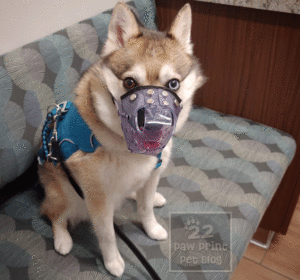
Two weeks ago now, I took Fenrir, my Alaskan Klee Kai , in for his annual checkup. Thankfully he got a clean bill of health. Except for the fact that 3+ years after his original diagnosis, he still tests positive for Lyme disease. The first time he tested positive was back in 2019. Despite little Fen otherwise being the picture of health, I decided to follow up on his positive Lyme snap test. Our vet ran a Quant C6 blood test (to check his Lyme antibody numbers). We also ran a urinalysis to check his kidney function. In some unfortunate cases, Lyme disease in dogs can lead to something called Lyme nephritis, a potentially deadly condition when Lyme disease impacts the kidneys.
Collecting urine samples from little male dogs is quite the task, let me tell you! It took me a handful of times, and getting peed on more times than I care to admit, before I got a sample that was good enough to bring into the vet. I didn’t end up dropping off Fen’s urine sample until around a week after his original appointment. That meant I had plenty of time to think…scratch that, overthink, things.
Fen is ok!
 Thankfully, earlier this week Fen’s vet got back to me with his test results. His Lyme antibody numbers are low (that’s a good thing) and the tests we ran to check his kidney function came back normal! I’m SO happy that that’s one less thing for me to stress about, for now.
All this research about kidneys and urine tests really put the topic of dogs and how they process water in the forefront of my brain. Despite Fen’s kidney results all coming back normal, his vet did mention that his urine was quite concentrated. This can be normal sometimes, such as when you’re testing first morning urine. But, it can also be a sign of dehydration.
How much water should our pets drink?
I think every good pet owner already knows, pets should have constant access to fresh, clean water. Giving your pet clean water everyday is one of the easiest things you can do for them. After all, unlike topics such as selecting your pet’s food, dental products, deciding how often to bathe them, and even what type of bowls to use for them, giving your pet water daily is pretty much a no-brainer!
But you should be monitoring how much water your pet drinks. Sudden changes in the amounts of water your pet consumes can be an indication that something is wrong. In addition, there are health issues that can be caused from not drinking enough (dehydration, kidney issues, organ failure), and even from over drinking (electrolyte imbalances, hyponatremia, bloat).
How much your pet should drink daily will depend on a lot of factors. Things such as the weather/temperature, how active your pet is, their size, and diet. A general rule for dogs is that you want to see them drink around 1 ounce (1/8th of a cup) of water for each pound of body weight daily. However, this is not a set in stone type of rule. Because there can be so many different factors that impact how much our pups drink, it’s a good idea to take the time to learn what’s a normal amount of water consumption for your individual pet. This way, you’ll more easily be able to recognize when/if they begin to deviate from their personal norm.

How to encourage your dog to drink more water?
I’m on a quest now to attempt to up Fenrir’s water intake. He does drink normally on his own, and (thankfully) his kidneys are healthy, but I think a bit more water daily might do him some good. Plus, it’s getting warmer here, and we’ve been spending a lot more time adventuring outside. Staying hydrated is especially important when it’s hot, and when you’re being physically active.
Around when we moved last September, I switched Kitsune and Fenrir (temporarily, or so I told myself) to kibble. I was having a hard time keeping up with making their home made diet while we looked for a new rental and packing. When Fen gets stressed he tends to develop a lot of stomach symptoms too. I found a sensitive stomach kibble that both dogs seemed to like and do well on. I had every intention of switching them back to their regular, homemade, diet after the move. Where the heck have the past 8 months gone!? We’re still not fully unpacked, by the way!
Long story slightly shorter, I’m finally getting back to feeding the boys a fresh, homemade diet. It’s quite a bit more work than just throwing some kibble in a bowl, but I think the added water content in the fresh food will be a good way to up Kit and Fen’s liquid intake, among many other benefits. I’ve also been offering them dog safe, flavored liquids such as a bit of bone broth or goat’s milk with their meals.

Using a water fountain verses a regular bowl seems to help encourage some pets, especially cats, to drink more. I’ve also noticed that my dogs, Fenrir in particular, are picky about their water. He drinks more if his water is fresh and clean, and less so if it sits for awhile or gets dirty. I’ve found that cleaning his water bowl and offering fresh water a few times a day seems to encourage him to drink more. Picky little mister!
And with that, I need to go get some water…
Filling your pet’s water bowl each day may mostly be a mindless task. But monitoring their fluid intake can definitely be beneficial. Sound off below! Do you monitor how much water your pet drinks each day? Has doing so ever helped you discover, or prevent, a health issue?

Recent Posts
While domestic mice and rats can make good pets, nobody enjoys having wild mice and/or rats living inside their home. They steal our food, can spread fleas and disease, and leave their droppings all...
Do you ever look outside, only to find your canine companion happily grazing on your lawn? Is your pooch famous for his or her cow impersonations? Why do some dogs eat grass anyways? No one...